
No 03 · Guide
How To Choose A Habit Cue: Examples And Reminders
By Sebastian Röhl, creator of HabitKit
9 min read Published Updated
Choose a cue you reliably encounter: finishing breakfast, arriving home, or a time when you are usually free. Write a specific plan: “After I make tea, I read one page.” A routine cue and a clock cue can both be useful; the trial discussed below found no clear advantage for either.
In HabitKit, put the cue in the habit name or description. A timed reminder can support the plan, but the app cannot detect that you have finished breakfast.
On this page

What This Means In HabitKit
A HabitKit reminder is a set of weekdays plus one time. There is no reminder that fires when you finish brushing your teeth, park the car, or close your laptop. The app cannot see any of that, and pretending otherwise would not help you.
So do the anchoring yourself.
- Put the anchor in the habit's Name or Description. "Floss after brushing" is a plan. "Floss" is a wish.
- Set the reminder for the time the anchor usually happens, not the time you would like to be the sort of person who does it. Set a reminder for a habit has the steps.
- If you have Pro, a home screen widget can keep the record visible. Treat it as another prompt; the cited studies did not test HabitKit widgets.
There is a practical ceiling here too. Each habit gets one reminder on the free tier and up to three with Pro. iOS also limits the number of pending notifications, so a large collection of reminders can exceed what the phone can schedule. Treat the notification as a backup for the plan rather than the plan itself. Reminder troubleshooting covers delivery problems.
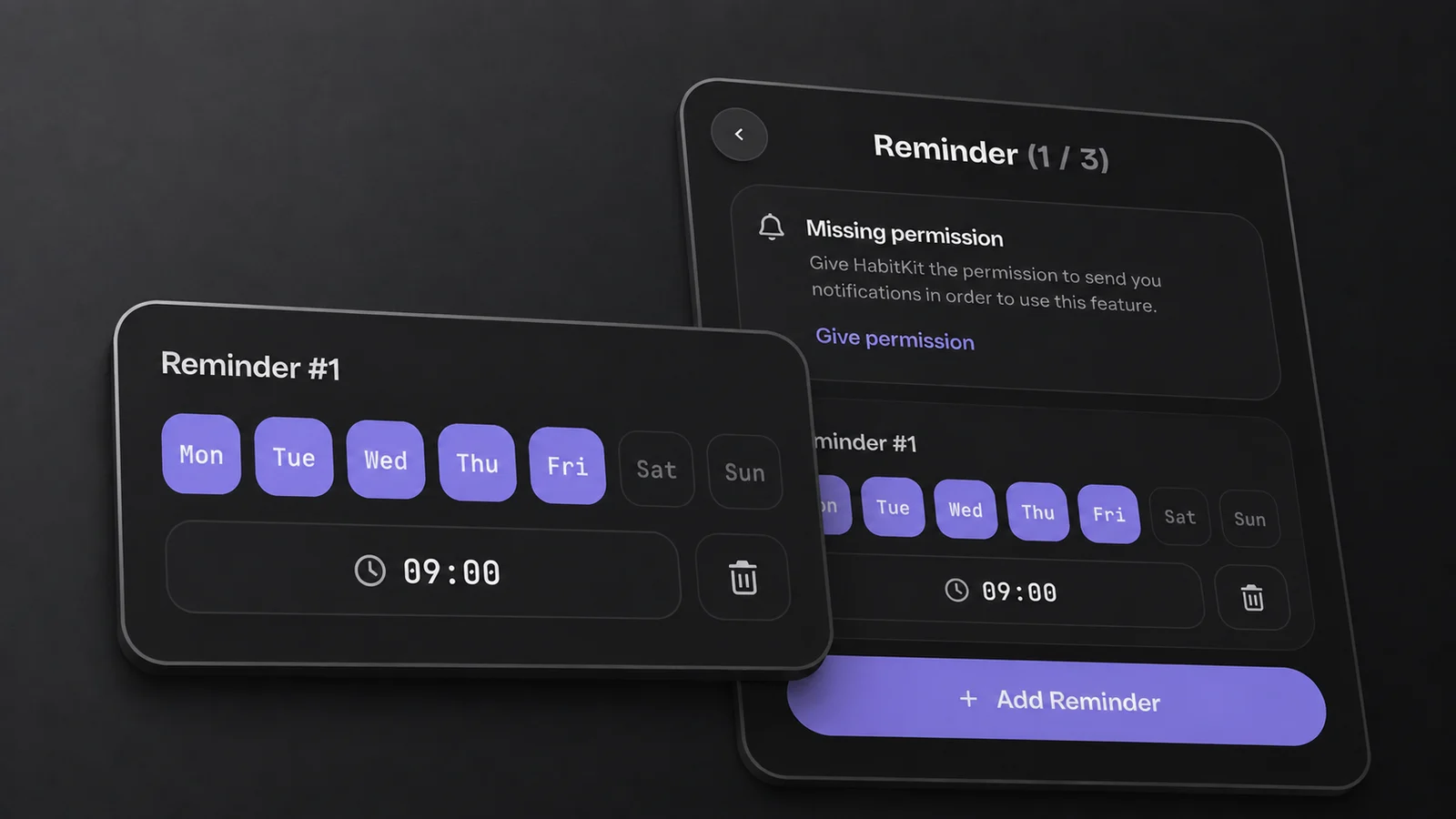
A weekday reminder at 09:00 in the demo. Notification permission still needs to be granted before it can fire.
Write The Plan As If-Then
The best-supported part of all this is not which cue you pick. It is that you decide the cue in advance and write it as a sentence with two halves: if situation Y happens, I will do X. Psychologists call these implementation intentions.
The form is doing work that a goal does not. "Read more" names an outcome and leaves every practical question open. "When I put the kettle on after dinner, I read a page while it boils" names a situation, a place, and an action small enough to picture. The second one can be checked against reality at the end of the day. The first one cannot.
The number everyone quotes comes from Gollwitzer and Sheeran, who pooled 94 independent tests across more than 8,000 participants and reported an effect on goal attainment of medium to large size, d = .65.
Worth saying out loud: that meta-analysis is a 2006 book-series chapter, assembled before preregistration was normal, from a literature that publication bias tends to flatter. Many of the included tests are short lab studies. Treat .65 as a summary of those studies, not a forecast for your own habit.
The health-behaviour numbers are smaller and more useful. Adriaanse and colleagues pooled 23 studies of implementation intentions and eating. Adding a healthy food to the diet came out at d = .51, cutting an unhealthy one at d = .29, and the authors noted in the same abstract that the healthy-eating figure may be inflated by weaker control conditions.
So write the plan. Expect a nudge, not a transformation.
Anchor To Something That Already Happens
Judah, Gardner and Aunger gave 50 people a flossing intervention. Half were told to floss before brushing, half after. At an eight-month follow-up the "after" group had stronger habits and flossed more often. The authors call the study exploratory themselves, and cue placement was not compared in the way a proper trial would compare it.
The reason it might work is easy to follow. Brushing happens every day whether or not you plan it, and it ends. A cue that reliably occurs and reliably finishes gives the new behaviour a slot instead of a vague window. Gardner, Lally and Wardle give the practical version in one line: choose "a time and place that you encounter every day of the week".
An event cue can work even when its clock time changes. "When I get home from work" may be useful if arriving reliably gives you a moment to act, whether that is at six or nine. "When I have a spare ten minutes" is not an anchor at all, it is a hope with a clock attached. And an anchor that never finishes, such as "while working", gives the behaviour nowhere in particular to land, which is why the flossing result is about the moment brushing ends rather than the general vicinity of the bathroom.
What A Small Reminder Study Found
Stawarz, Cox and Blandford ran a four-week study of cue types and positive reinforcement alongside a review of 115 habit-formation apps. Their conclusion, in their own words: "relying on reminders supported repetition but hindered habit development, while the use of event-based cues led to increased automaticity; positive reinforcement was ineffective."
This suggests a possible tradeoff: a notification can support repetition while becoming the thing you rely on to remember. It does not establish that reminders always prevent a habit from forming. Automaticity is the thing that would otherwise take over; how a behaviour becomes automatic covers what it is and how it is measured.
This was a small four-week study, not a large trial. Which brings us to the trial.
What The Larger Cue-Planning Trial Found
Keller and colleagues randomised 192 adults, aged 18 to 77, to plan an everyday nutrition behaviour against either a daily routine cue or a specific time cue, then asked them the same questions every day for 84 days. The study was preregistered. Both conditions raised automaticity and plan enactment. No between-condition differences were found. What predicted automaticity was repeated plan enactment, at the within-person and the between-person level alike.
Among the participants who did form a habit, reaching peak automaticity took a median of 59 days, with a spread from 4 to 335. Read that median the way you would read any other. It describes 27 people, the ones whose curve levelled off above the middle of the automaticity scale, and the paper counts them as 23% of the 117 who followed the protocol. The 18 to 77 is a range rather than a description, too. The mean age was 24.76 and 86.5% of the sample were women.
Two studies, two directions, and no tidy resolution on offer. Keller is the larger, preregistered, head-to-head test, which counts for a great deal. It also covers one behaviour domain, in a German online sample, with self-reported automaticity. Stawarz points the other way but is small and is not a randomised trial. The honest reading is that the case against clock cues is suggestive and unsettled, and that the thing both studies agree on is repetition. The plan has to get enacted, again and again, in the same context.
Aim At Something, Not Away From It
Oscarsson and colleagues followed 1,066 people from the Swedish general public through a year of New Year's resolutions. Of those who responded at follow-up, 55% counted themselves successful. Split by framing, approach-oriented goals, the ones phrased as doing something, succeeded 58.9% of the time against 47.1% for avoidance-oriented goals phrased as stopping something.
The caveats matter. Success was self-rated, attrition was substantial so "of responders" is doing real work in that 55%, and people chose their own framing rather than being assigned one, which makes the comparison quasi-experimental rather than a clean test.
It points the same way as the eating meta-analysis, where adding beat subtracting. So if you have a choice, phrase the habit as something to do. HabitKit tracks the other kind too, and track a habit you want to quit explains how the grid handles it. If a replacement action helps, you can give it a separate habit of its own. The comparison does not predict how difficult your particular goal will be.
Sources
- Gollwitzer, P. M., & Sheeran, P. (2006). Implementation intentions and goal achievement: A meta-analysis of effects and processes. Advances in Experimental Social Psychology, 38, 69-119. 10.1016/S0065-2601(06)38002-1
- Adriaanse, M. A., Vinkers, C. D. W., De Ridder, D. T. D., Hox, J. J., & De Wit, J. B. F. (2011). Do implementation intentions help to eat a healthy diet? A systematic review and meta-analysis of the empirical evidence. Appetite, 56(1), 183-193. 10.1016/j.appet.2010.10.012
- Judah, G., Gardner, B., & Aunger, R. (2013). Forming a flossing habit: An exploratory study of the psychological determinants of habit formation. British Journal of Health Psychology, 18(2), 338-353. 10.1111/j.2044-8287.2012.02086.x
- Gardner, B., Lally, P., & Wardle, J. (2012). Making health habitual: the psychology of habit-formation and general practice. British Journal of General Practice, 62(605), 664-666. 10.3399/bjgp12X659466
- Stawarz, K., Cox, A. L., & Blandford, A. (2015). Beyond self-tracking and reminders: Designing smartphone apps that support habit formation. Proceedings of the 33rd Annual ACM Conference on Human Factors in Computing Systems (CHI '15), 2653-2662. 10.1145/2702123.2702230
- Keller, J., Kwasnicka, D., Klaiber, P., Sichert, L., Lally, P., & Fleig, L. (2021). Habit formation following routine-based versus time-based cue planning: A randomized controlled trial. British Journal of Health Psychology, 26(3), 807-824. 10.1111/bjhp.12504
- Oscarsson, M., Carlbring, P., Andersson, G., & Rozental, A. (2020). A large-scale experiment on New Year's resolutions: Approach-oriented goals are more successful than avoidance-oriented goals. PLOS ONE, 15(12), e0234097. 10.1371/journal.pone.0234097
Linking one's nutrition behaviour to a daily routine or a specific time was similarly effective for habit formation