No 04 · Habit science
How Habits Become Automatic
By Sebastian Röhl, creator of HabitKit
6 min read Published Updated
A habit becomes more automatic when a familiar cue begins to prompt an action with less deliberate remembering. Repeating the action in a stable context can help, but a long streak alone does not prove this has happened.
A tracker records what you did. To judge whether a habit is becoming easier, also notice whether you remember it without a notification and how much effort it takes to begin.
On this page

What A Filled Tile Records
For a build habit, a full tile means you met that day's target. It does not establish that the action felt automatic. Quit habits work differently: an unlogged clean day fills automatically, so a coloured tile is not proof of a check-in either.
Review these questions alongside your record:
- Did you remember the action without a notification?
- Did the same event or place prompt you to start?
- Was beginning easier than it was a few weeks ago?
These are informal reflection prompts, not a scored research questionnaire. If remembering is still difficult, try a more reliable cue before raising your target. Choose a habit cue gives examples.
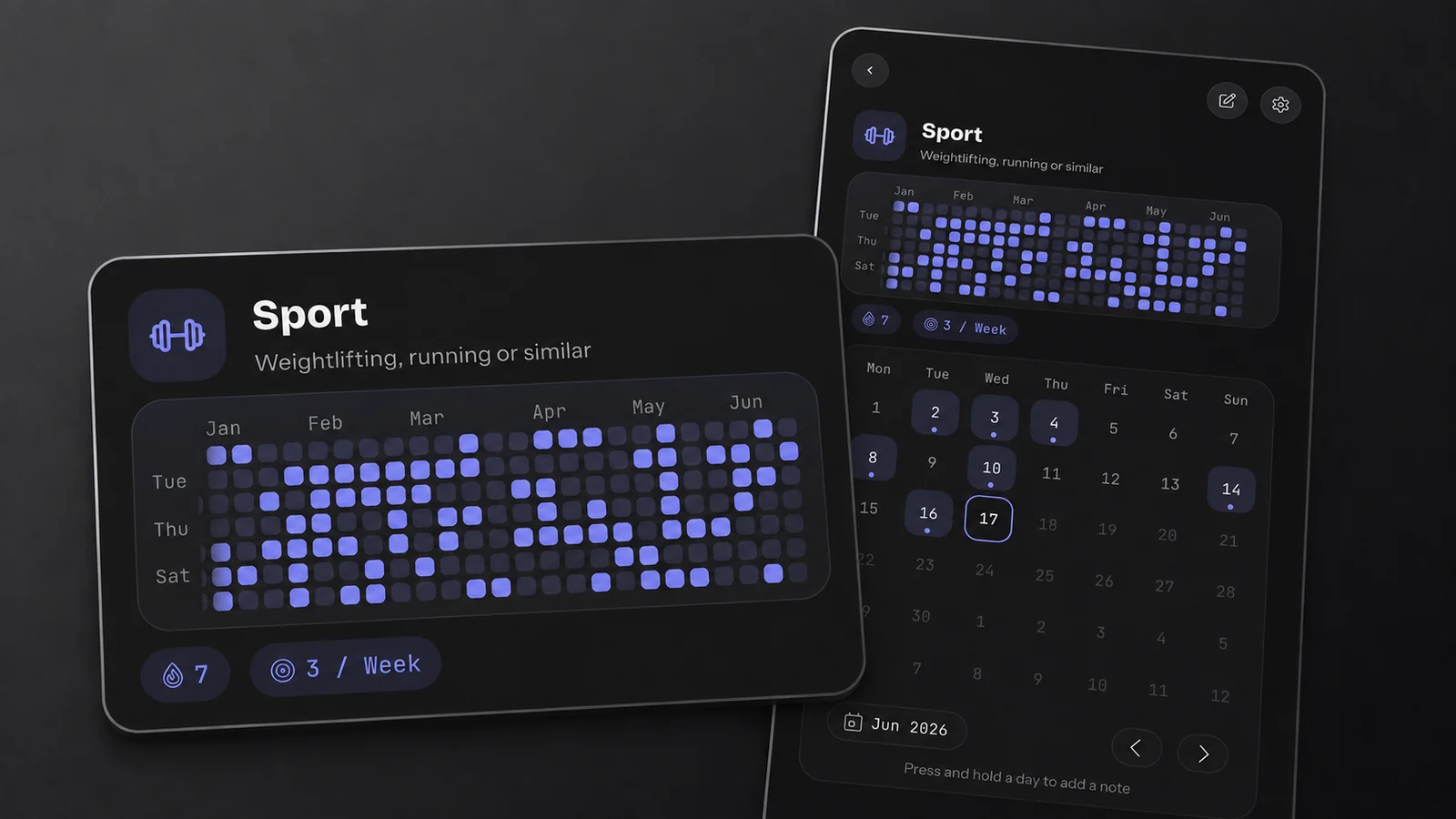
Demo data showing recorded days. The grid cannot show whether those actions felt automatic.
Progress monitoring can still be useful even when an action remains deliberate. Harkin and colleagues' meta-analysis found a small-to-moderate improvement in goal attainment from monitoring interventions. It studied monitoring broadly, not HabitKit or this grid design. The evidence on maintaining habits covers that distinction.
What Researchers Mean By Habit
Benjamin Gardner's 2015 review is the definition most of the field now works from. "Habit is a process by which a stimulus generates an impulse to act as a result of a learned stimulus-response association," he writes, and then adds the part that gets dropped in translation: those impulses "may compete or combine with impulses and inhibitions arising from other sources, including conscious decision-making, to influence responses, and need not generate behaviour."
A habit is the impulse, not the action. You can have a strong habit and override it. You can perform a behaviour a hundred times out of pure deliberate effort and have no habit at all.
Wendy Wood and Dennis Rünger, reviewing the field for Annual Review of Psychology in 2016, describe habit and deliberate goal pursuit as guiding actions "synergistically, although habits are the efficient, default mode of response." They also note something that should make anyone with a tracking app pause: people "tend to infer from the frequency of habit performance that the behavior must have been intended." We read frequency backwards as evidence of intent, including our own.
How Automaticity Is Measured
Researchers often ask people how automatic a behaviour feels. The four-item Self-Report Behavioural Automaticity Index asks whether it is something they do automatically, without consciously remembering, without thinking, and before realising they are doing it.
These questions are useful for distinguishing repetition from automaticity. They are also self-reports, not direct observations of a mental process. Use them as prompts for reflection, not as a diagnosis or a pass/fail test.
The Shape Of The Curve
The familiar habit curve rises quickly and then levels off. In Lally and colleagues' 2010 study, it fitted well for 39 of the 82 participants with enough data to analyse. Others had flat, poorly fitting or implausible curves, or a model could not be fitted.
A poor fit does not prove that a person cannot form a habit. It means this model did not adequately describe their reported progress. The study followed people for 84 days; estimates beyond that were projections. How long habit formation takes explains the sample and timings in detail.
Progress need not be smooth. A later trial by Keller and colleagues also discusses modelling shapes that can rise and then decline. Expect variation rather than comparing your experience with one ideal curve.
How Much Of Life Is Habit
You will see it said that 43% of daily actions are habits. That is a real number attached to a claim it cannot support.
It comes from Wendy Wood, Jeffrey Quinn and Deborah Kashy's 2002 diary studies, in which undergraduates at Texas A&M (70 in the first study, 209 in the second) recorded what they were doing at hourly intervals. The sentence in the paper reads: "between a third and a half of all behaviors listed were classified as habits, given that they were performed just about every day and usually in the same location." Study 2 gave 43%, Study 1 gave 35%.
So it is not 43% of your actions. It is 43% of the behaviours a group of American psychology undergraduates chose to write down, in one of two studies, using a definition of habit based on frequency and location. The authors' own phrasing, a third to a half, is the one to repeat.
The same study found that when people were doing something habitual, their thoughts were usually about something else entirely. That is a better description of what automaticity feels like from the inside than any percentage.
Sources
- Gardner, B. (2015). A review and analysis of the use of 'habit' in understanding, predicting and influencing health-related behaviour. Health Psychology Review, 9(3), 277-295. 10.1080/17437199.2013.876238
- Wood, W., & Rünger, D. (2016). Psychology of habit. Annual Review of Psychology, 67, 289-314. 10.1146/annurev-psych-122414-033417
- Verplanken, B., & Orbell, S. (2003). Reflections on past behavior: A self-report index of habit strength. Journal of Applied Social Psychology, 33(6), 1313-1330. 10.1111/j.1559-1816.2003.tb01951.x
- Gardner, B., Abraham, C., Lally, P., & de Bruijn, G.-J. (2012). Towards parsimony in habit measurement: Testing the convergent and predictive validity of an automaticity subscale of the Self-Report Habit Index. International Journal of Behavioral Nutrition and Physical Activity, 9, 102. 10.1186/1479-5868-9-102
- Lally, P., van Jaarsveld, C. H. M., Potts, H. W. W., & Wardle, J. (2010). How are habits formed: Modelling habit formation in the real world. European Journal of Social Psychology, 40(6), 998-1009. 10.1002/ejsp.674
- Keller, J., Kwasnicka, D., Klaiber, P., Sichert, L., Lally, P., & Fleig, L. (2021). Habit formation following routine-based versus time-based cue planning: A randomized controlled trial. British Journal of Health Psychology, 26(3), 807-824. 10.1111/bjhp.12504
- Wood, W., Quinn, J. M., & Kashy, D. A. (2002). Habits in everyday life: Thought, emotion, and action. Journal of Personality and Social Psychology, 83(6), 1281-1297. 10.1037/0022-3514.83.6.1281
- Harkin, B., Webb, T. L., Chang, B. P. I., Prestwich, A., Conner, M., Kellar, I., Benn, Y., & Sheeran, P. (2016). Does monitoring goal progress promote goal attainment? A meta-analysis of the experimental evidence. Psychological Bulletin, 142(2), 198-229. 10.1037/bul0000025
Habit is a process by which a stimulus generates an impulse to act as a result of a learned stimulus-response association.