No 17 · Comparison
The Best Habit Tracker Apps For ADHD
By Sebastian Röhl, creator of HabitKit
23 min read Published
The best habit tracker for ADHD is one that is quick to log, keeps the habit in front of you, and doesn't punish a missed day by wiping out your progress. HabitKit, Tiimo, Finch, Habitica and Streaks each do that in a different way, and which one fits depends on whether you need a gentle nudge, a structured day or a little outside pressure.
No app treats ADHD, and none of these has been tested in a trial with people who have it. What the research does support is a handful of strategies that habit apps happen to be built around: reminders that arrive at the right moment, a visible record of your progress, and plans tied to a time and a place. We go through that evidence first, including where it runs out, and then compare the apps against it.
Full disclosure: HabitKit is our app, and we put it first because it is the one we would pick. Every app here gets the same treatment anyway: real strengths, real weaknesses and facts dated to the day we checked them. There are no affiliate links, and no app paid to be on this list.
-
 HabitKit · Best Overall
Each habit as a grid where a missed day is one gap, not a reset, with one tap to log.
4.8/5 from HabitKit's editors
HabitKit · Best Overall
Each habit as a grid where a missed day is one gap, not a reset, with one tap to log.
4.8/5 from HabitKit's editors
-
 Tiimo · Best Visual Day Planner
A calm visual timeline with focus timers, co-designed with ADHD and autism experts.
4.5/5 from HabitKit's editors
Tiimo · Best Visual Day Planner
A calm visual timeline with focus timers, co-designed with ADHD and autism experts.
4.5/5 from HabitKit's editors
-
 Finch · Gentlest On Hard Days
Self-care goals that look after a virtual pet, with the core free and no account.
4.3/5 from HabitKit's editors
Finch · Gentlest On Hard Days
Self-care goals that look after a virtual pet, with the core free and no account.
4.3/5 from HabitKit's editors
-
 Habitica · Best For Accountability
Habits as a role-playing game, with friends whose quests depend on you.
4.1/5 from HabitKit's editors
Habitica · Best For Accountability
Habits as a role-playing game, with friends whose quests depend on you.
4.1/5 from HabitKit's editors
-
 Streaks · Best For Logging Itself
Apple Health completes fitness habits, and widgets and the Watch tick the rest.
4.0/5 from HabitKit's editors
Streaks · Best For Logging Itself
Apple Health completes fitness habits, and widgets and the Watch tick the rest.
4.0/5 from HabitKit's editors
Written by the maker of HabitKit, who wants you in the app that suits you. The stars are our own editorial rating out of five, not store ratings. Tiimo, Finch, Habitica and Streaks are named for comparison only; HabitKit is not affiliated with their makers. Prices and features come from the US App Store, Google Play and each developer's own site on the date above.
On this page
Quick Comparison
| App | Best for | Price (US) | Platforms | Our rating |
|---|---|---|---|---|
| 1. HabitKit | Seeing progress that survives a missed day | Free for four habits. Pro monthly, yearly or lifetime | iPhone, Android | 4.8/5 |
| 2. Tiimo | Planning the day visually | Free basic planner. Pro subscription | iPhone, iPad, Mac, Apple Watch, Android, web | 4.5/5 |
| 3. Finch | Gentle self-care goals | Core free. Plus $9.99 a month or $69.99 a year | iPhone, iPad, Android | 4.3/5 |
| 4. Habitica | Accountability with friends | Free. Optional $4.99 a month or $47.99 a year | iPhone, iPad, Android, Wear OS, web | 4.1/5 |
| 5. Streaks | Habits that log themselves | $5.99 one-time | iPhone, iPad, Mac, Apple Watch, Vision Pro | 4.0/5 |
"Our rating" is our own judgment against the criteria below, not a store rating. Store ratings are listed in each app's section.
What The Research Says About ADHD And Habits
Why Routines Can Be Harder
On average, people with ADHD score lower than people without it on lab tests of planning, working memory and stopping an automatic response. A review of 83 studies put those differences at a medium size, and its authors were careful to add that the weaknesses are "neither necessary nor sufficient" to explain every case. Plenty of people with ADHD score in the normal range, and lab scores line up only loosely with how someone's everyday life goes.
Two findings matter more for habits than the rest:
- Remembering to do something at a set time. In a small study of 25 adults with ADHD and 25 without, the ADHD group did much worse at acting at a planned time, but no worse at acting when a cue appeared in front of them. A later study found adults with ADHD carried out fewer of their own real-life intentions. That is the clearest research case for an outside reminder.
- Rewards that are far away feel weaker. Across 25 comparisons and nearly 4,000 people, those with ADHD discounted delayed rewards more steeply than those without, in children and adults alike. A habit's payoff is usually months away; a tile filling in today is not.
"Time blindness" is a popular phrase rather than a research term. Studies do find differences in judging durations, but over milliseconds and seconds in a lab, and nobody has shown that those cause everyday lateness.
What Helps People Follow Through
- Tracking your progress. A meta-analysis of 138 experiments found that monitoring progress toward a goal helped people reach it, and helped more when the progress was physically recorded. That was the general population, not ADHD. In one small study of 41 college students with ADHD, adding self-monitoring to study skills and goal setting improved grades and goal attainment.
- If-then plans. "If it's 8 am and I've poured my coffee, then I take my vitamins." In lab studies of boys with ADHD, these plans helped them hold back impulsive responses as well as boys without ADHD, and a 2026 meta-analysis of children found a small-to-medium effect that may be larger in ADHD. We found no trial in adults with ADHD.
- Learning to run the day with tools. Cognitive behavioural therapy for adult ADHD teaches planning, organising and reminder systems, and trials find it helps, though a Cochrane review rated the evidence low quality. The most relevant trial for this page taught 57 adults with ADHD to structure their day with smartphone apps in a coached six-week course; inattention improved more than in a waitlist group. Coaching was part of it, so it doesn't show apps work on their own.
What We Don't Know
No habit tracker has been tested in people with ADHD. A review of 109 ADHD apps in the app stores found that none offered any evidence they work, and reviews of digital tools for ADHD in general describe small effects from low-quality studies. Anyone who tells you an app will fix your focus is ahead of the evidence.
Why A Missed Day Matters More Than It Should
There is no research on streaks in ADHD either, but the general research points one way. A single missed day did not materially slow habit formation in a well-known study of 96 volunteers. In seven studies, a broken streak shown in a log made people less likely to keep going, even when their actual history was the same, and the drop was bigger when they blamed themselves and smaller when the streak could be repaired. Goals with a few planned "emergency reserve" days kept people going after a miss, and in a study of 61,293 gym members the most effective program rewarded people for coming back after a missed workout.
Put that next to one more finding, that adults with ADHD report lower self-compassion on average in surveys, and the design question is obvious, even if the ADHD link itself is untested: an app should make it easy to come back, not make the miss the loudest thing on the screen. Our guide to what one missed day does to a habit goes through those studies in detail.
What To Look For In A Habit App
From that evidence, and from what adults with ADHD say about habit apps in forums and interviews, five things matter:
- Logging in one tap, or from a widget or notification. Every extra step is a chance to forget.
- A reminder you can place at the right moment. Time-based remembering is the weak spot; an alert is the cue.
- Progress you can see at a glance. A filled-in record now, not a promise in three months.
- A missed day that doesn't erase everything. Room for days off, or a history that keeps the good weeks visible.
- Very little to set up. One habit to start. People in ADHD forums describe abandoning apps after setting up ten habits on day one.
Features Compared
| HabitKit | Tiimo | Finch | Habitica | Streaks | |
|---|---|---|---|---|---|
| iPhone | Yes | Yes | Yes | Yes | Yes |
| Android | Yes | Yes | Yes | Yes | No |
| Reminders | Yes, one per habit free, three with Pro | Yes | Not checked | Yes | Yes |
| Home screen widgets | Yes, with Pro | Yes | Yes, shows your pet | Yes | Yes |
| Apple Watch app | No | Yes | No | No | Yes |
| Free to start | Four habits | Basic planner | Core features | The whole game | No |
| Works without an account | Yes | Not checked | Yes | No | Yes |
| Says it is designed for ADHD | No | Yes | No | Mentions ADHD | No |
"Not checked" means we couldn't confirm it either way on the date at the top.
How We Evaluated
We weighed the five points above, in that order, then price and platforms. Every fact about an app comes from its App Store or Google Play listing, its developer's website or help center, checked on the date at the top, and we read recent low-star reviews for each app's weaknesses. Every research claim links to the study in the sources at the end.
The 5 Best Habit Tracker Apps For ADHD
HabitKitNo 01 · Best Overall
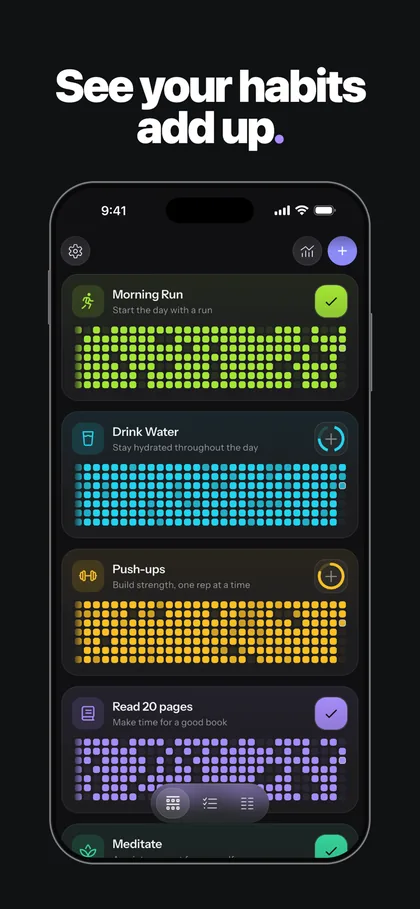
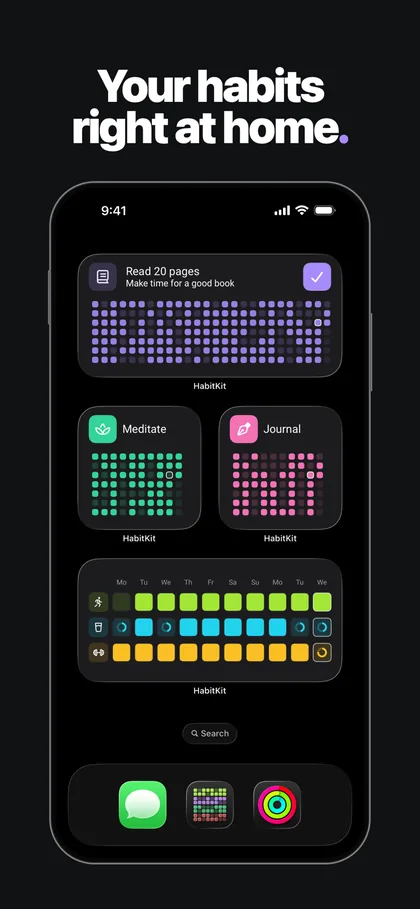
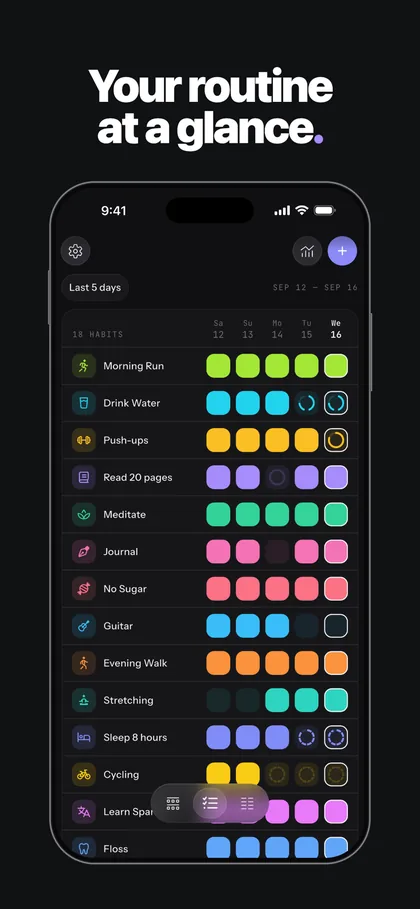
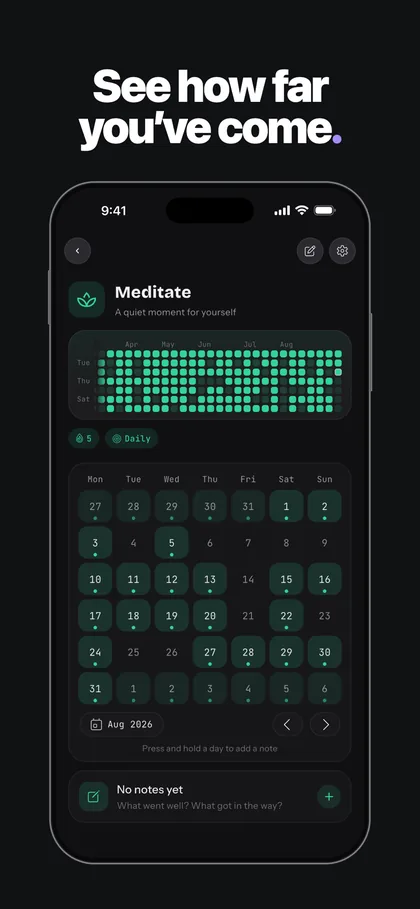
Screenshots from HabitKit's App Store listing.
HabitKit draws every habit as a grid, one tile per day. A good month is a solid block of colour, and a missed day is one gap in it, with the weeks before it still on screen. The streak number on the dashboard is off unless you turn it on, so the first thing you see is the record, not a counter at zero.
It's built to be quick. One tap logs a habit, Count and Measure habits fill a day's tile partway, and on Android a reminder's notification has buttons that complete the habit without opening the app. If a daily goal is too rigid, a weekly or monthly goal builds the days off into the plan, so five days out of seven is a success rather than two failures (taking a day off).
What it does well
- A missed day stays a gap, not a reset of everything you've done (how streaks are counted).
- Weekly and monthly goals for habits you won't do every day.
- Fast logging, from the app, from Pro widgets, or from notification buttons on Android (reminders).
- Little to set up and no account. Four habits are free for good, which is more than enough to start.
Where it falls short
- One reminder per habit on the free plan. Pro raises it to three, and widgets need Pro too.
- No skip or rest days. A planned day off and a forgotten one look the same in the grid; weekly goals are the workaround.
- No Apple Watch app, no Apple Health and no sync. Nothing logs itself; Streaks does more of that.
- Pricing
- Free for four habits. Pro comes as a monthly or yearly subscription or a one-time Lifetime purchase; prices vary by country and are shown in the app.
- Platforms
- iPhone and Android.
- Ratings
- 4.8 from 2,484 ratings on the US App Store, 4.6 on Google Play.
TiimoNo 02 · Best Visual Day Planner
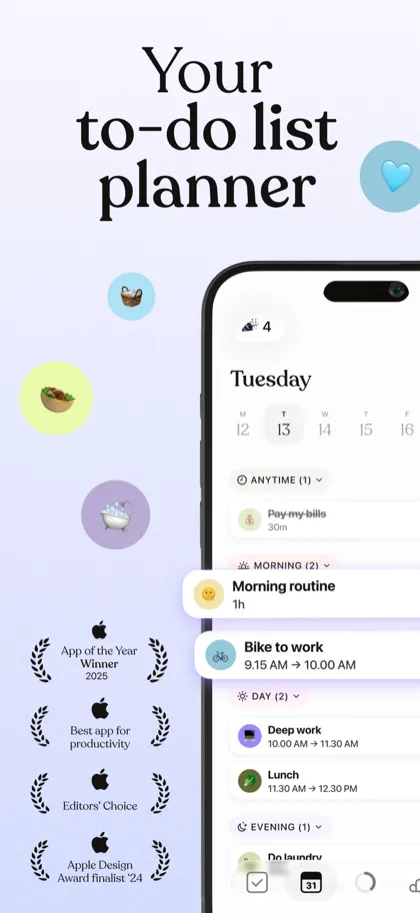
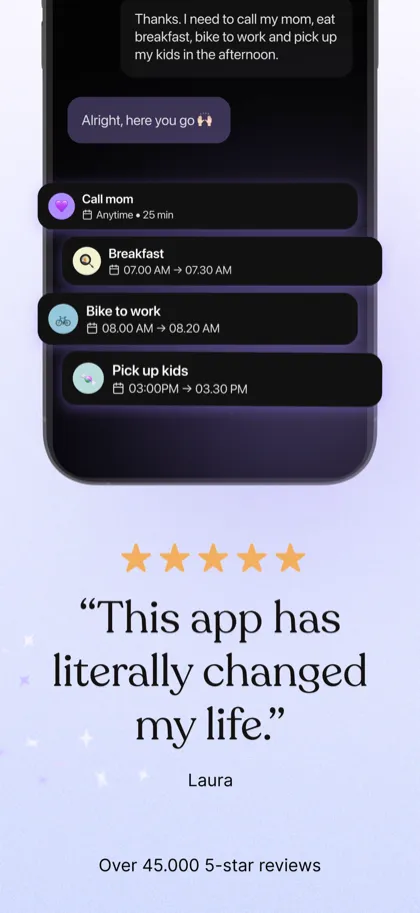
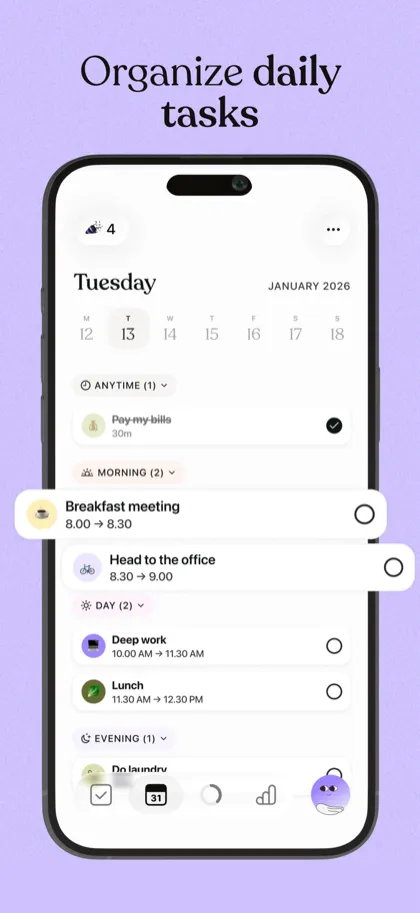
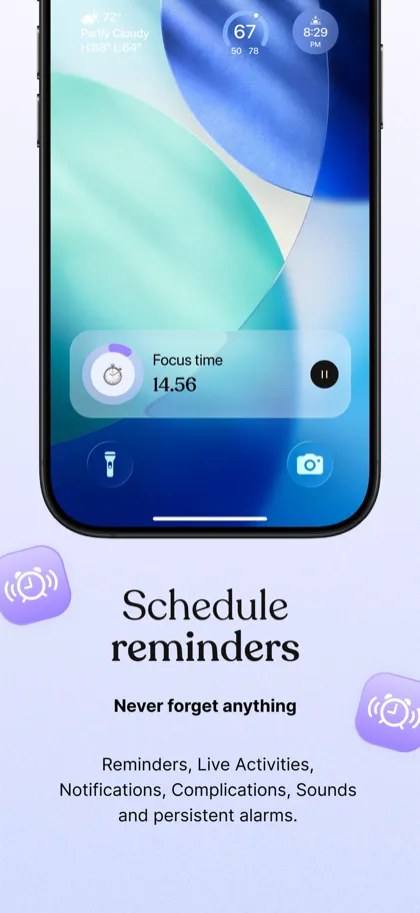
Screenshots from the Tiimo listing on the App Store. Images by its developer.
Tiimo isn't a habit tracker. It's a visual day planner, and it's here because it's the one app on this list made for ADHD from the start: its listing says it was "co-designed with ADHD/Autism experts". Your day is a colourful timeline grouped into morning, day and evening, tasks can be broken into steps by an AI helper, and a calm focus timer counts down on the Lock Screen, in the Dynamic Island and on Apple Watch.
For routines it works well: put the morning routine on the timeline every day and the planner becomes the cue. What it doesn't do is show how a habit has gone over the past months.
What it does well
- Designed with ADHD and autism in mind, and says so.
- Time made visible, with a timeline and timers on the Lock Screen and Watch.
- No ads, in the listing's words "100% ad-free forever".
Where it falls short
- A planner, not a tracker. There's no long-term record of a habit.
- The useful parts are a subscription. The free version is a basic planner, and the trial applies only to the yearly plan, which recent reviews call frustrating.
- Onboarding. A September 2026 Play review says there is "virtually no onboarding process".
- Pricing
- A free basic planner. Tiimo Pro is a monthly or yearly subscription; the US App Store lists in-app purchases from $7.00 to $54.00 without saying which is which, and Tiimo shows your local price at checkout.
- Platforms
- iPhone, iPad, Mac, Apple Watch, Android and the web (the web needs Pro).
- Ratings
- 4.6 from 20,888 ratings on the US App Store and 4.6 on Google Play.
FinchNo 03 · Gentlest On Hard Days

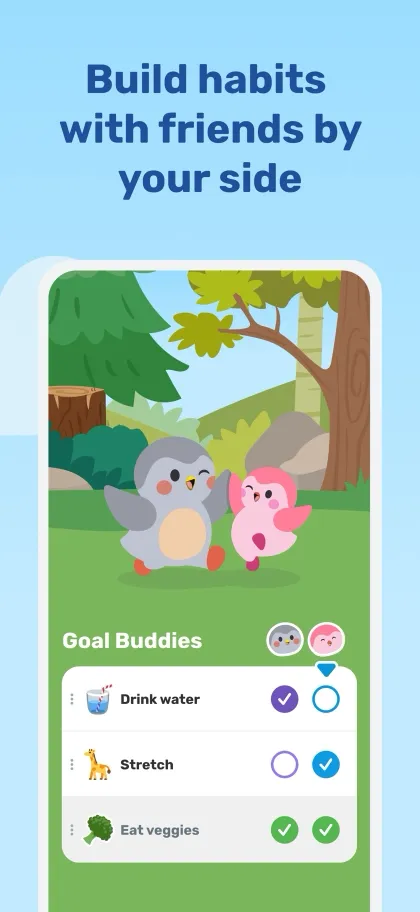
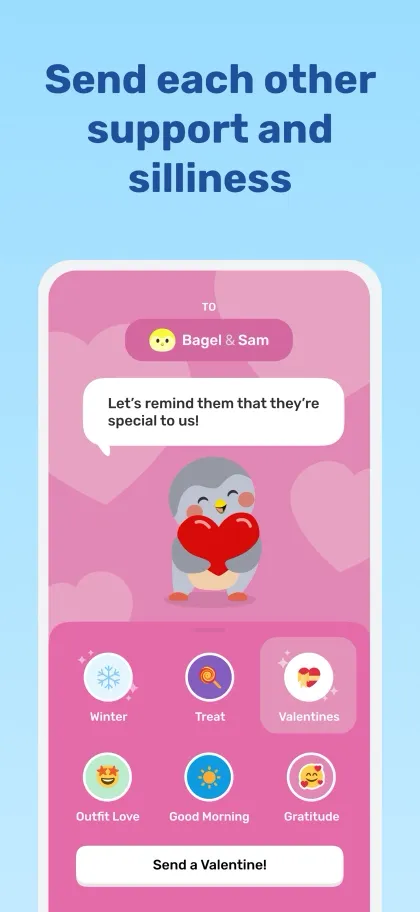

Screenshots from the Finch listing on the App Store. Images by its developer.
Finch turns self-care goals into looking after a small bird. Every goal you complete, from "get out of bed" to "drink water", gives your pet energy for its adventures, and friends can share goals and send each other encouragement. Its help center says streaks "are meant to encourage gentle consistency", and the whole app has that tone.
The core is free, permanently according to Finch, and your data stays on your phone unless you choose to create an account for cloud backups.
What it does well
- Small goals count, which suits the days when getting up is the win.
- A gentle tone instead of pressure.
- Free core and no account needed.
Where it falls short
- A self-care app first. It doesn't show a habit's long-term history the way a tracker does.
- The widget shows your pet, not your goals, as a reminder to check in.
- Shrinking free rewards, according to long-time users in recent Play reviews.
- Pricing
- The core is free. Finch Plus is $9.99 a month or $69.99 a year, according to its help center.
- Platforms
- iPhone, iPad and Android.
- Ratings
- 4.9 from more than 763,000 ratings on the US App Store and 4.9 on Google Play.
HabiticaNo 04 · Best For Accountability
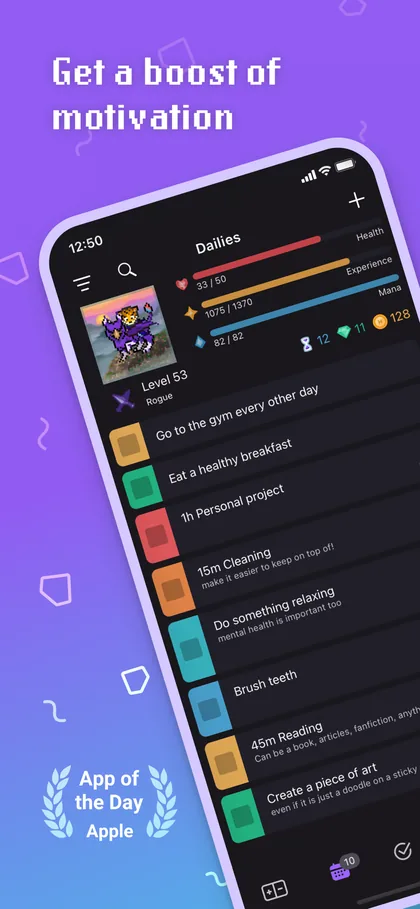
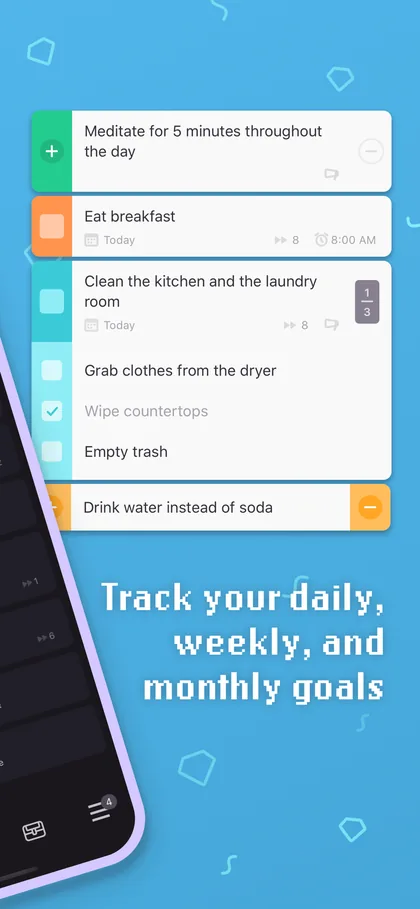
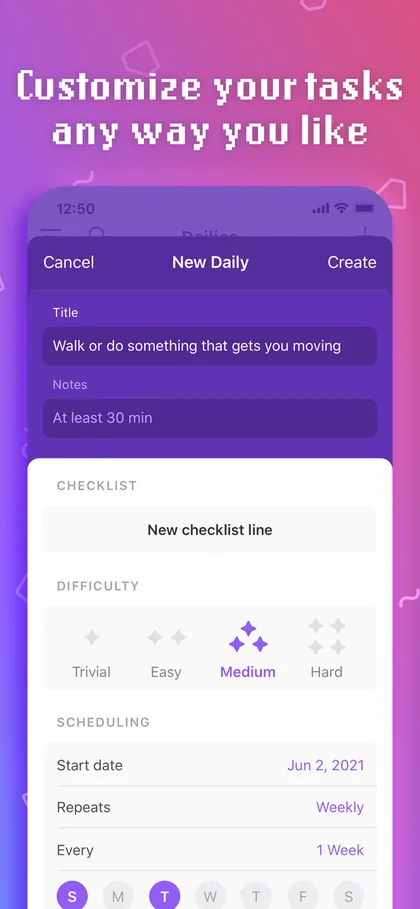

Screenshots from the Habitica listing on the App Store. Images by its developer.
Habitica makes the payoff immediate. Completing a habit earns your character experience and gold right now, and skipping a daily costs it health. Join a party and your friends' quests depend on you too, which is the kind of outside accountability many people with ADHD say helps. Its own listing mentions ADHD, and Apple has featured it in a story about apps for managing ADHD.
What it does well
- Instant rewards for a habit whose real payoff is months away.
- Friends who notice when you skip.
- Free, on phone, watch and web.
Where it falls short
- A lot to take in. The game adds menus, gear and pets, and reviews describe it as messy to navigate.
- Punishment is part of the design. Missing dailies hurts your character, which motivates some people and discourages others.
- Ads on Android and an account to sign up for.
- Pricing
- Free. An optional subscription costs $4.99 a month, $14.99 for three months, $29.99 for six months or $47.99 a year.
- Platforms
- iPhone, iPad, Android, Wear OS and the web.
- Ratings
- 4.3 from 3,522 ratings on the US App Store and 4.6 on Google Play.
StreaksNo 05 · Best For Logging Itself
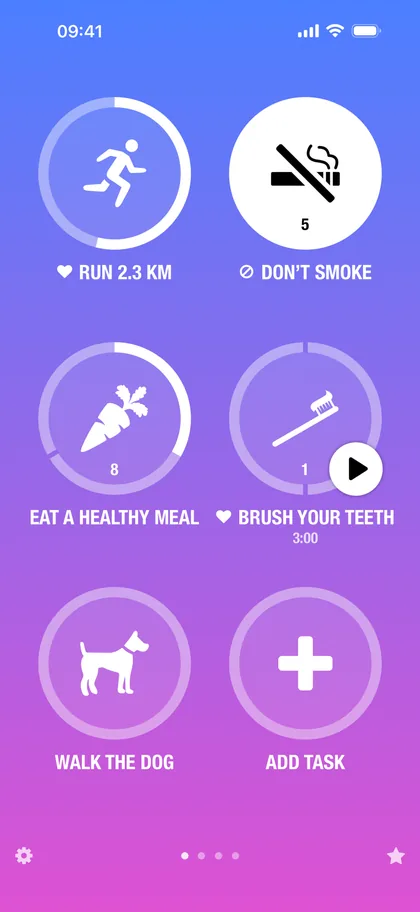
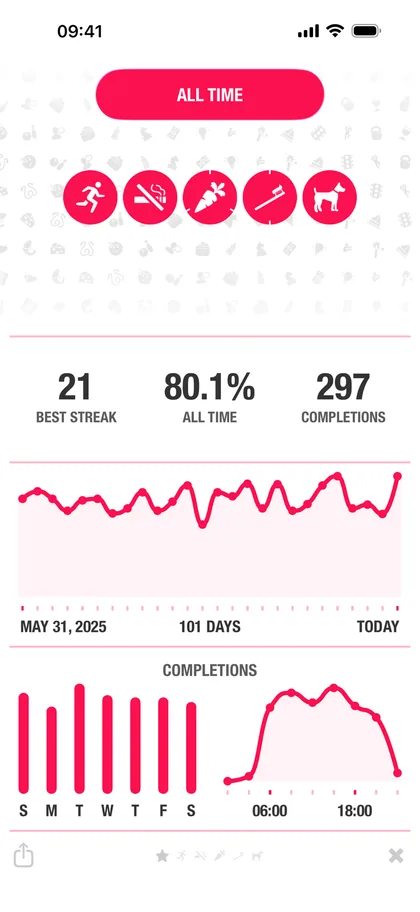
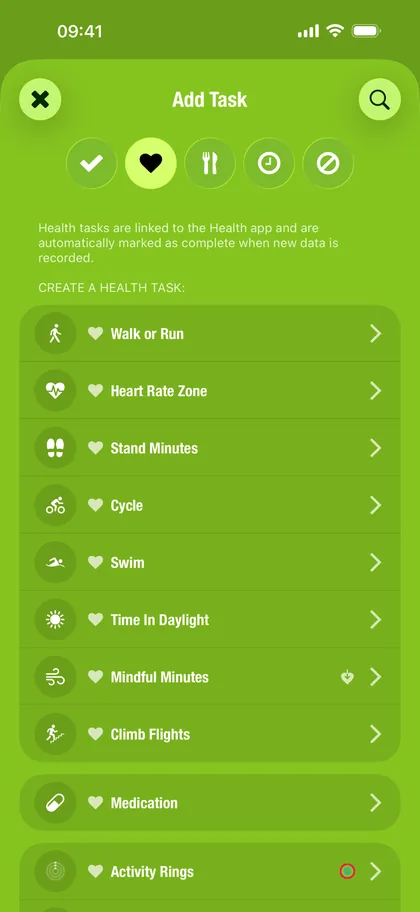
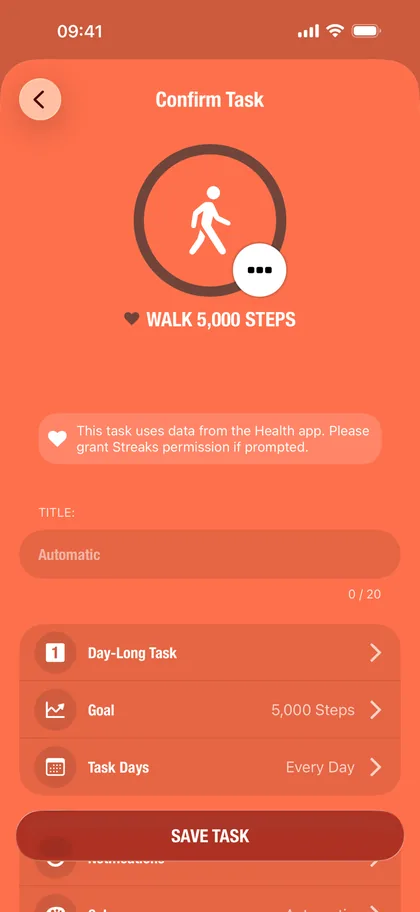
Screenshots from the Streaks listing on the App Store. Images by its developer.
The best way not to forget to log a habit is not to have to. Connect Streaks to Apple Health and it completes walking, workouts and mindful minutes by itself. Everything else can be ticked from a widget, from Control Center or from the Apple Watch, and reminders arrive automatically.
What it does well
- Fitness habits log themselves through Apple Health.
- Tick off from anywhere: widgets, Control Center and the Watch.
- One $5.99 payment, with no upgrade screens.
Where it falls short
- Built around the streak. Each task's streak count is the centre of the main screen, which motivates some people and stings for others after a miss.
- Apple only. There's no Android version.
- No free version to try first, and at most 24 tasks.
- Pricing
- $5.99 once on the US App Store, with no in-app purchases.
- Platforms
- iPhone, iPad, Mac, Apple Watch and Vision Pro.
- Ratings
- 4.8 from 27,352 ratings on the US App Store.
Which One Should You Pick?
- If you want to see your habits add up, and come back after a missed day without starting over: pick HabitKit.
- If structuring the whole day is the hard part: pick Tiimo, and pair it with a tracker if you want a long-term record.
- If you need gentleness more than data: pick Finch.
- If you follow through better when others are counting on you: pick Habitica.
- If forgetting to log is the problem, and you're on Apple devices: pick Streaks.
Making A Habit App Work With ADHD
Start with one habit. Not five. Our guide to starting smaller than feels worthwhile explains why a tiny version done every day beats an ambitious one done twice.
Tie it to something you already do. A cue that is part of your routine, such as after coffee or when you sit at your desk, is easier to act on than a time to remember, and in one study of habit apps it helped behaviours become automatic in a way reminders alone did not. Choosing a cue you will actually notice goes through how.
Use the reminder anyway. For habits you keep forgetting, a reminder at the moment of the cue is the backup. There is no rule that says you have to stop using it.
Plan the days off. A goal of five days a week is still a goal. Write the slack in before you need it, so a missed day is part of the plan instead of a verdict.
Tell someone. A friend who asks, a coach, or a party in Habitica. Tracking helps more when progress is shared.
Frequently Asked Questions
Do Habit Tracker Apps Help With ADHD?
They aren't a treatment, and no habit tracker has been tested in people with ADHD. They do package strategies that research supports in general, such as reminders, recording your progress and planning when and where, and those are the same tools taught in therapy for adult ADHD.
Are Streaks Bad For ADHD?
There's no ADHD-specific research either way. General studies find a broken streak makes people less likely to continue, especially when they blame themselves, and that one missed day barely affects habit formation. An app that keeps your history visible after a miss, or lets you plan days off, avoids the worst of it.
What Is The Best Free Habit App For ADHD?
HabitKit is free for four habits for good, with a reminder for each and no account. Finch's core is free, and Habitica's whole game is free.
Is Tiimo A Habit Tracker?
Not exactly. Tiimo is a visual day planner with timers. You can put a routine on its timeline every day, but it doesn't keep a long-term record of a habit the way a tracker does.
How Many Habits Should I Track At Once?
Start with one or two. People often abandon a tracker after setting up too many habits at once; add the next one only when the first is running without effort.
Final Thoughts
ADHD doesn't make habits impossible, and no study shows that it does. It makes some parts harder: remembering at the right moment, caring about a payoff that's months away, and shrugging off a bad day. The right app helps with exactly those parts, and the wrong one adds a fresh reason to feel behind.
Pick one app, one habit and one cue, and give it a few weeks. If a day goes missing, the only thing that matters is the next one.
HabitKit is free for four habits, takes a minute to set up and keeps your habits on your phone. Get it on the App Store or Google Play.
Sources
Checked on the date at the top of this page. App names, icons and screenshots belong to their developers and are shown to identify and illustrate each app; HabitKit is not affiliated with any of them.
Research
- Willcutt, E. G., Doyle, A. E., Nigg, J. T., Faraone, S. V., & Pennington, B. F. (2005). Validity of the executive function theory of ADHD: a meta-analytic review. Biological Psychiatry, 57(11), 1336-1346. 10.1016/j.biopsych.2005.02.006
- Toplak, M. E., West, R. F., & Stanovich, K. E. (2013). Do performance-based measures and ratings of executive function assess the same construct? Journal of Child Psychology and Psychiatry, 54(2), 131-143. 10.1111/jcpp.12001
- Altgassen, M., Kretschmer, A., & Kliegel, M. (2014). Task dissociation in prospective memory performance in individuals with ADHD. Journal of Attention Disorders, 18(7), 617-624. 10.1177/1087054712445484
- Altgassen, M., Scheres, A., & Edel, M.-A. (2019). Prospective memory (partially) mediates the link between ADHD symptoms and procrastination. ADHD Attention Deficit and Hyperactivity Disorders, 11(1), 59-71. 10.1007/s12402-018-0273-x
- Jackson, J. N., & MacKillop, J. (2016). Attention-deficit/hyperactivity disorder and monetary delay discounting: a meta-analysis of case-control studies. Biological Psychiatry: Cognitive Neuroscience and Neuroimaging, 1(4), 316-325. 10.1016/j.bpsc.2016.01.007
- Marx, I., Cortese, S., Koelch, M. G., & Hacker, T. (2022). Meta-analysis: altered perceptual timing abilities in ADHD. Journal of the American Academy of Child & Adolescent Psychiatry, 61(7), 866-880. 10.1016/j.jaac.2021.12.004
- Harkin, B., Webb, T. L., Chang, B. P. I., et al. (2016). Does monitoring goal progress promote goal attainment? A meta-analysis of the experimental evidence. Psychological Bulletin, 142(2), 198-229. 10.1037/bul0000025
- Scheithauer, M. C., & Kelley, M. L. (2017). Self-monitoring by college students with ADHD: the impact on academic performance. Journal of Attention Disorders, 21(12), 1030-1039. 10.1177/1087054714553050
- Gawrilow, C., & Gollwitzer, P. M. (2008). Implementation intentions facilitate response inhibition in children with ADHD. Cognitive Therapy and Research, 32(2), 261-280. 10.1007/s10608-007-9150-1
- Breitwieser, J., & Reinelt, T. (2026). The effectiveness of implementation intentions in children: a systematic review and meta-analysis. British Journal of Psychology. 10.1111/bjop.70065
- Lopez, P. L., Torrente, F. M., Ciapponi, A., et al. (2018). Cognitive-behavioural interventions for attention deficit hyperactivity disorder (ADHD) in adults. Cochrane Database of Systematic Reviews, CD010840. 10.1002/14651858.CD010840.pub2
- Moëll, B., Kollberg, L., Nasri, B., Lindefors, N., & Kaldo, V. (2015). Living SMART: a randomized controlled trial of a guided online course teaching adults with ADHD or sub-clinical ADHD to use smartphones to structure their everyday life. Internet Interventions, 2(1), 24-31. 10.1016/j.invent.2014.11.004
- Păsărelu, C. R., Andersson, G., & Dobrean, A. (2020). Attention-deficit/hyperactivity disorder mobile apps: a systematic review. International Journal of Medical Informatics, 138, 104133. 10.1016/j.ijmedinf.2020.104133
- Gabarron, E., Denecke, K., & Lopez-Campos, G. (2025). Evaluating the evidence: a systematic review of reviews of the effectiveness and safety of digital interventions for ADHD. BMC Psychiatry, 25, 414. 10.1186/s12888-025-06825-0
- Lally, P., van Jaarsveld, C. H. M., Potts, H. W. W., & Wardle, J. (2010). How are habits formed: modelling habit formation in the real world. European Journal of Social Psychology, 40(6), 998-1009. 10.1002/ejsp.674
- Silverman, J., & Barasch, A. (2023). On or off track: how (broken) streaks affect consumer decisions. Journal of Consumer Research, 49(6), 1095-1117. 10.1093/jcr/ucac029
- Sharif, M. A., & Shu, S. B. (2021). Nudging persistence after failure through emergency reserves. Organizational Behavior and Human Decision Processes, 163, 17-29. 10.1016/j.obhdp.2019.01.004
- Milkman, K. L., Gromet, D., Ho, H., et al. (2021). Megastudies improve the impact of applied behavioural science. Nature, 600, 478-483. 10.1038/s41586-021-04128-4
- Beaton, D. M., Sirois, F., & Milne, E. (2022). The role of self-compassion in the mental health of adults with ADHD. Journal of Clinical Psychology, 78(12), 2497-2512. 10.1002/jclp.23354
- Stawarz, K., Cox, A. L., & Blandford, A. (2015). Beyond self-tracking and reminders: designing smartphone apps that support habit formation. Proceedings of CHI 2015, 2653-2662. 10.1145/2702123.2702230
- National Institute of Mental Health. ADHD in adults: 4 things to know
Apps