No 04 · Guide
AI Habits That Make You Sharper, Not Just Faster
By Sebastian Röhl, creator of HabitKit
12 min read Published
AI can make you faster, and it can make you sharper too. The difference is in how you use it. To stay sharp in the age of AI, build a few small habits: have a go yourself before you ask, ask for hints and explanations rather than only finished answers, let AI quiz you, ask it to challenge your thinking, and keep a few skills in regular practice.
These habits are practical suggestions built on the research below, not a programme any single study tested. The research points in an encouraging direction: used well, AI helps people learn as well as get more done.
On this page
AI Makes People Faster And Better At Their Work
The productivity results are strong. In a preregistered experiment published in Science, Shakked Noy and Whitney Zhang gave 453 college-educated professionals writing tasks from their own occupations and let half of them use ChatGPT. The average time taken fell by 40% and output quality rose by 18%.
Erik Brynjolfsson, Danielle Li and Lindsey Raymond followed 5,172 customer-support agents as an AI assistant was introduced in stages. Issues resolved per hour rose by 15% on average. Less experienced and lower-skilled agents improved both the speed and the quality of their work, and the authors found evidence that AI assistance facilitates worker learning.
That last finding is the one this guide builds on. The same tool that speeds up the work can help people get better at it.
AI Can Teach, Too
The most striking result comes from an introductory physics course at Harvard. Greg Kestin and colleagues built an AI tutor on the same teaching principles as the course's own active-learning lessons. It kept students actively working, managed how much they had to take in at once, and walked them through each part of each problem in order. The researchers supplied prepared solutions and used a custom platform to control that sequence. In a randomised crossover trial with 194 students, each student learned one topic from the tutor at home and another in class.
In the authors' words: "We find that students learn significantly more in less time when using the AI tutor, compared with the in-class active learning." On immediate post-lesson tests, median learning gains in the AI group were more than double those in class. Median time with the tutor was 49 minutes, compared with an estimated 60 minutes of learning during the class, and students reported feeling more engaged and more motivated. The experiment did not measure how much they retained months later.
The Setup Is What Makes The Difference
Hamsa Bastani and colleagues ran a randomised experiment with nearly a thousand high school maths students in Turkey. Classes practised with their usual resources or with one of two GPT-4 tools. GPT Base resembled a standard chat assistant. GPT Tutor was instructed to give hints rather than answers, with teacher-provided solutions and guidance on common mistakes included in its prompts.
Both versions improved performance during assisted practice: grades were 48% higher with GPT Base and 127% higher with GPT Tutor than in the control group. On the subsequent unaided exam, the GPT Base group scored 17% lower than the control group. The GPT Tutor group's scores were statistically indistinguishable from the control group's: its safeguards largely prevented the drop, but did not produce a significant exam improvement. These are relative differences, not percentage-point changes.
Together, these studies make a useful case for AI that keeps the learner involved. They tested different settings and purpose-built tutors, so a few chat prompts cannot be assumed to reproduce their results. The habits below borrow their design principles and combine them with established learning research.
Have A Go Before You Ask
This idea is much older than AI. A 2007 meta-analysis by Sharon Bertsch and colleagues pooled 86 studies of the generation effect: people remember material they produce themselves better than material they only read. Across those studies the advantage was an effect size of 0.40, almost half a standard deviation.
So give yourself the first move. Write a rough paragraph, sketch the outline, or spend ten minutes on the problem, then bring AI in to compare, improve and explain. Your attempt gives AI something specific to work with, and gives you something to remember. The studies used word lists and simple problems rather than AI, so treat this as a sensible order of work, not a tested recipe.
Ask For Hints And Explanations
Both research tutors were designed to guide students through the work. You can try the same principle in your own chats by asking for a hint, attempting the next step, and then checking your understanding:
- "Don't solve it yet. Give me a hint."
- "Walk me through this one step at a time, and let me try each step first."
- "Explain why this works, then ask me a question to check I understood."
When you do want the finished answer, and often you will, ask for the reasoning with it and read that part too.
Let AI Quiz You
Recalling something is one of the most reliable ways to learn it. In two experiments, Henry Roediger and Jeffrey Karpicke had students study prose passages and then either take recall tests or restudy the material. On final tests two days or a week later, the students who had practised recalling remembered substantially more, even though restudying made the other students more confident. Their conclusion: "Testing is a powerful means of improving learning, not just assessing it."
AI can make preparing practice questions much easier. Give it the chapter or notes you want to learn from, then ask:
- "Quiz me on this chapter, one question at a time. Wait for my answer before you tell me if I'm right."
- "Give me five questions about what we covered yesterday, starting with the hardest."
Answer from memory before looking back, and check the AI's questions and feedback against your source material. The 2006 study used free-recall tests without feedback, not AI-generated quizzes, so these prompts apply the idea rather than repeat what it tested.
Ask AI To Challenge Your Thinking
Hao-Ping (Hank) Lee and colleagues surveyed 319 knowledge workers, who described 936 examples of using generative AI. Participants described critical thinking shifting toward verifying information, integrating responses and overseeing the task. People who were more confident in their own ability to do the task reported more critical thinking; people who were more confident in the AI reported less. These were self-reported associations, not a test showing that AI caused a change in thinking ability.
A practical habit to try is asking AI for a counterargument. The survey did not test whether these prompts improve critical thinking:
- "What is the strongest objection to this?"
- "Which part of your answer are you least sure about?"
- "What would have to be true for the opposite to be right?"
Then check the one claim that matters most against a source before you rely on it.
Keep A Few Skills In Hand
Aviation has lived with powerful automation for decades and offers a useful analogy, rather than direct evidence about AI. The US Federal Aviation Administration calls autoflight systems "useful tools for pilots" that "have improved safety and workload management". Its 2013 safety alert encourages airlines to make sure pilots understand when to use automation, such as during high workload, and to provide appropriate opportunities for manual practice within their operating policies.
A simulator study of 16 airline pilots by Stephen Casner and colleagues found their hands-on flying skills mostly intact. The thinking side of manual flight showed more problems, such as keeping track of the aircraft's position without the map display, and the authors suggest those skills may depend on how actively pilots stay engaged while the automation flies.
Research on skill retention says the same thing more generally. A 1998 meta-analysis of 53 articles by Winfred Arthur Jr. and colleagues found substantial skill loss after long periods without practice, with cognitive, accuracy-based tasks more susceptible than physical, speed-based ones.
So pick two or three skills you care about and give each a small, regular rep: write a first draft yourself once a week, do the mental arithmetic before you check it, or work on a bug for fifteen minutes before you ask. These are starting points, not tested practice schedules. Use AI freely for other tasks, while checking results where accuracy matters. Letting tools carry some of the mental work is as familiar as keeping a shopping list.
Track Your AI Habits In HabitKit
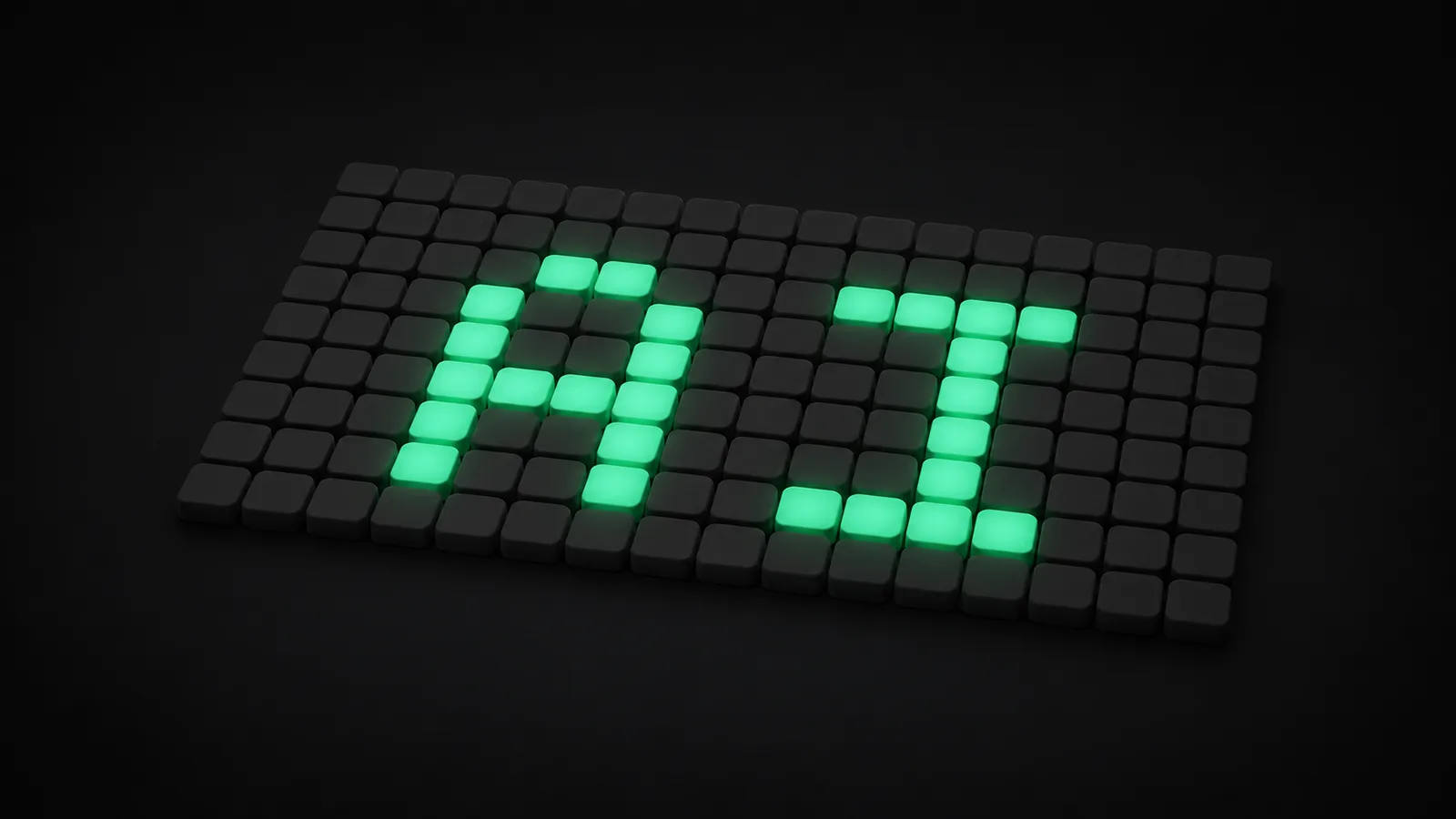
Pick one or two of the habits above and add each as its own habit in HabitKit, such as "Quizzed by AI" or "Drafted before asking", with Yes / No under Tracking. The cover image is a stylised illustration of an example habit, with illustrative completion data. HabitKit tracks the practice; you do the AI-assisted learning in your chosen AI tool. Then give the habit a weekly shape:
- Open the habit and tap the edit icon.
- Tap Streak Goal.
- Choose Week and set Completions Per Interval to 3, shown as 3 / Week.
- Go back to the edit screen and tap Save.
Three successful days a week leaves room for busy ones. This is an example schedule, not a frequency established by the studies. Take a day off without breaking your streak explains how the weekly goal counts.
Set a Reminder for a time you usually start work, and pair the practice with a cue such as opening your laptop. Reminders are scheduled by time and day. Set a reminder for a habit shows where it lives, and how to choose a habit cue covers why the cue matters. The day editor's note field, which asks "What went well? What got in the way?", is a good place to write down one thing you learned; log a completion and fix a past day covers notes.
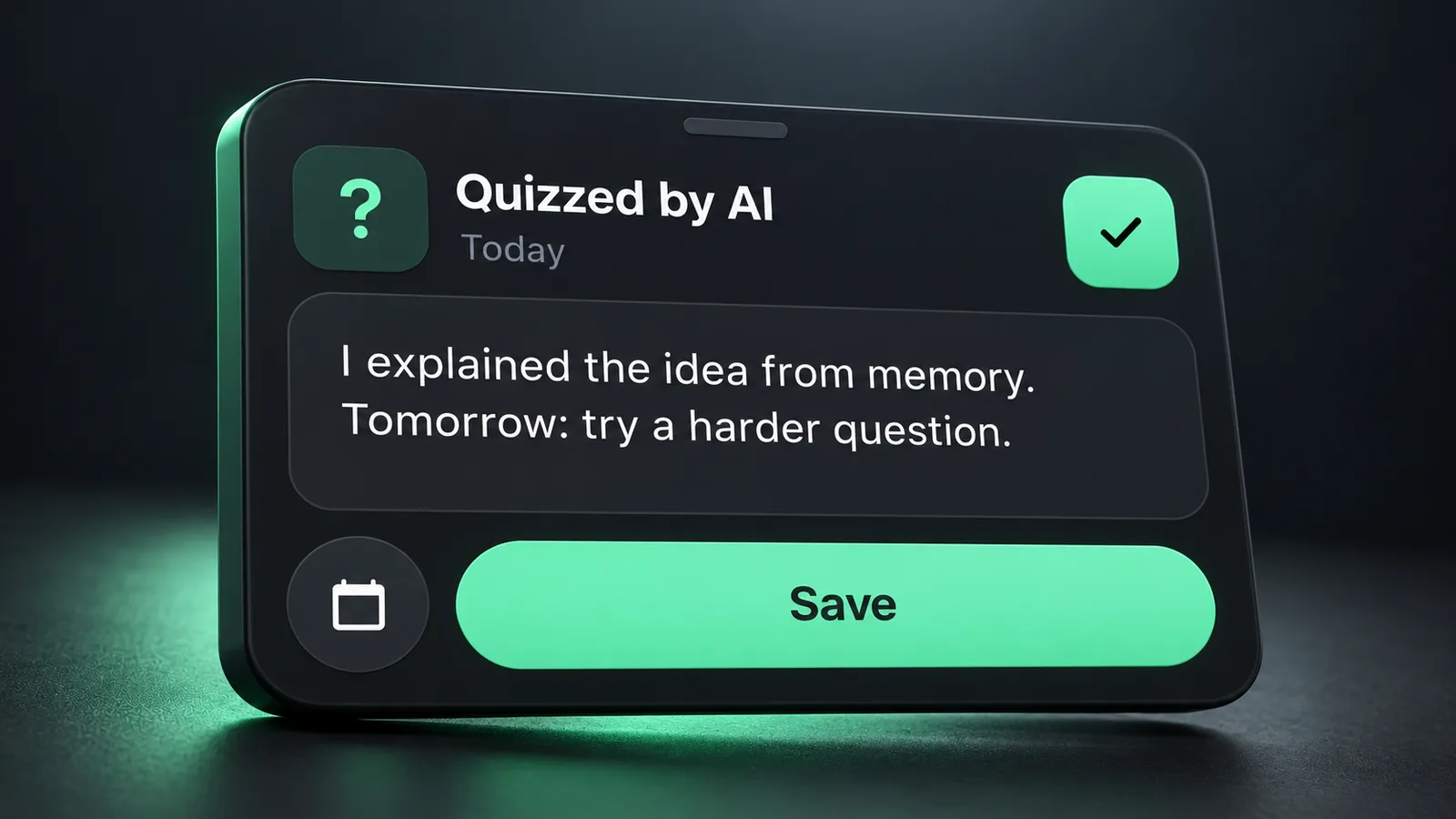
An illustrative learning note in HabitKit's day editor. Record what you practised and what you want to try next.
A record will not do the habit for you. A meta-analysis of 138 studies by Benjamin Harkin and colleagues found that monitoring progress helped people reach their goals on average, with larger effects when progress was physically recorded, though that is not a result for any particular app. Start smaller than feels worthwhile: one quiz a week that you actually do beats a daily plan you drop. How to start a small habit you can repeat has more on choosing the first version.
What The Research Does Not Tell You Yet
These studies are strong, but each covers a particular setting: writing tasks in an online experiment, one company's support team, one physics course, one group of high school maths students. The gains were not the same for everyone either. In the support study, the most experienced and highest-skilled agents saw small gains in speed and small declines in quality, and the Harvard team notes that its tutor was used while students were meeting the material for the first time.
The cited studies do not test this exact set of habits or establish that it improves general thinking ability over the long term. They combine recent AI results with learning research that is much older than AI. Treat the habits as experiments you can run on yourself: try one for a few weeks, and check what you can explain or do unaided, as well as how quickly you finish.
Sources
- Noy, S., & Zhang, W. (2023). Experimental evidence on the productivity effects of generative artificial intelligence. Science, 381(6654), 187-192. 10.1126/science.adh2586
- Brynjolfsson, E., Li, D., & Raymond, L. (2025). Generative AI at work. The Quarterly Journal of Economics, 140(2), 889-942. 10.1093/qje/qjae044
- Kestin, G., Miller, K., Klales, A., Milbourne, T., & Ponti, G. (2025). AI tutoring outperforms in-class active learning: An RCT introducing a novel research-based design in an authentic educational setting. Scientific Reports, 15, 17458. 10.1038/s41598-025-97652-6
- Bastani, H., Bastani, O., Sungu, A., Ge, H., Kabakcı, Ö., & Mariman, R. (2025). Generative AI without guardrails can harm learning: Evidence from high school mathematics. Proceedings of the National Academy of Sciences, 122(26), e2422633122. 10.1073/pnas.2422633122
- Bertsch, S., Pesta, B. J., Wiscott, R., & McDaniel, M. A. (2007). The generation effect: A meta-analytic review. Memory & Cognition, 35(2), 201-210. 10.3758/BF03193441
- Roediger, H. L., & Karpicke, J. D. (2006). Test-enhanced learning: Taking memory tests improves long-term retention. Psychological Science, 17(3), 249-255. 10.1111/j.1467-9280.2006.01693.x
- Lee, H.-P., Sarkar, A., Tankelevitch, L., Drosos, I., Rintel, S., Banks, R., & Wilson, N. (2025). The impact of generative AI on critical thinking: Self-reported reductions in cognitive effort and confidence effects from a survey of knowledge workers. Proceedings of the 2025 CHI Conference on Human Factors in Computing Systems, 1-22. 10.1145/3706598.3713778
- Federal Aviation Administration. (2013). Manual flight operations (Safety Alert for Operators 13002). faa.gov
- Casner, S. M., Geven, R. W., Recker, M. P., & Schooler, J. W. (2014). The retention of manual flying skills in the automated cockpit. Human Factors, 56(8), 1506-1516. 10.1177/0018720814535628
- Arthur, W., Jr., Bennett, W., Jr., Stanush, P. L., & McNelly, T. L. (1998). Factors that influence skill decay and retention: A quantitative review and analysis. Human Performance, 11(1), 57-101. 10.1207/s15327043hup1101_3
- Harkin, B., Webb, T. L., Chang, B. P. I., Prestwich, A., Conner, M., Kellar, I., Benn, Y., & Sheeran, P. (2016). Does monitoring goal progress promote goal attainment? A meta-analysis of the experimental evidence. Psychological Bulletin, 142(2), 198-229. 10.1037/bul0000025
We find that students learn significantly more in less time when using the AI tutor, compared with the in-class active learning.