
No 10 · Guide
When Is The Best Time To Start A New Habit?
By Sebastian Röhl, creator of HabitKit
7 min read Published Updated
Start when you can give a small action a workable cue and a realistic place in your day. You do not need to wait for January. A Monday, birthday or other fresh start may help you begin, but beginning and continuing are different outcomes.
A change of routine can create an opening for a new habit. It can also leave you with less time and energy, so choose a manageable action rather than treating disruption as a deadline.
On this page

Start In An Ordinary Week
You can start without a major life change. Pick an existing event in your day, choose one manageable action and prepare what you need.
For example, put a book beside the place where you drink your morning tea. Read a page after making the tea. Try it across an ordinary week, then adjust if the cue or target was impractical. This example applies the idea of a stable context; it is not a tested prescription.
In HabitKit, put the action in Name and the cue in Description. Choose Yes / No for a simple check-in. Set a weekly goal if daily practice does not suit the habit. Create your first habit explains the setup.
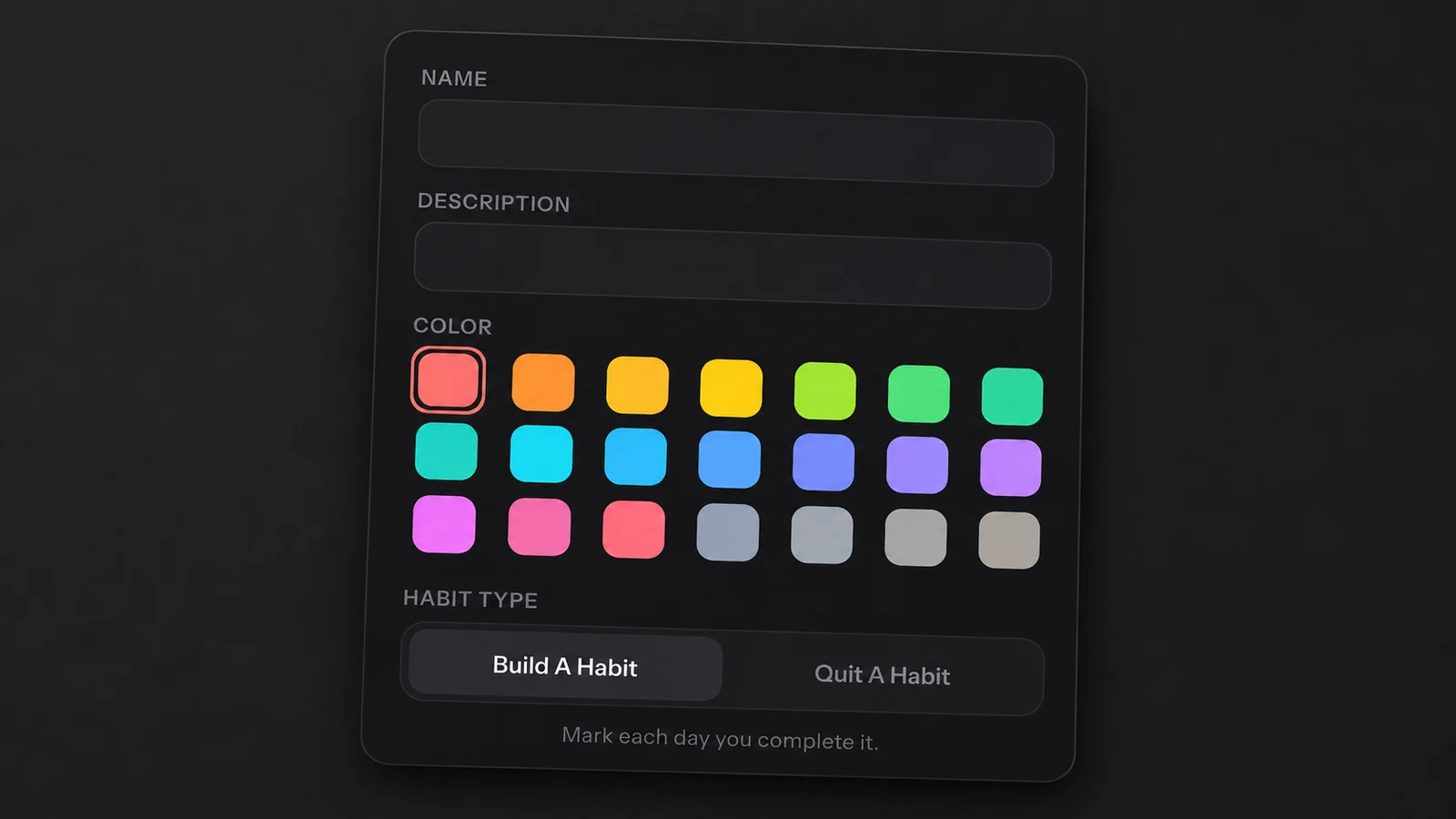
The New Habit editor gives the action and its cue a place. The screenshot shows an empty example.
If choosing an action is the hard part, try one of these five habits for a focused working week. If you miss a day, resume at the next realistic opportunity.
What Happens To Resolutions
Norcross and Vangarelli followed 200 New Year's resolvers for two years. Seventy-seven percent were still keeping the pledge after one week. Nineteen percent were still keeping it after two years.
The shape in between is the interesting part: 55% at one month, 43% at three months, 40% at six. The cliff is not somewhere out in March. It falls between week one and month one, and almost nothing is lost between three months and six.
This is a 1988 American study of self-selected resolvers, with self-reported outcomes and no control group, so treat the exact percentages as a sketch rather than a measurement. The shape has held up well enough to keep being cited, and the shape is what matters here. Whatever you are going to do about attrition, you have to do it in the first month.
One more number from the same paper, because it reframes what "successful" meant. Fifty-three percent of the people counted as successful slipped at least once, and across the two years the average resolver recorded fourteen slips. Success in this data set was never a clean run. It was a run that resumed. The successful group also reported having leaned more on stimulus control, which is the research vocabulary for arranging your surroundings so the behaviour is cued and the alternative is inconvenient. That part is retrospective self-report and should be read as a description of what worked for them rather than as a proven cause.
The Fresh Start Effect, And What It Is Not
Dai, Milkman and Riis coined the fresh start effect across three archival field studies. Google searches for "diet", visits to a university gym, and commitments people made on a goal-setting site all rose after temporal landmarks: the start of a new week, month, year or semester, and the days after a birthday or a holiday. The proposed mechanism is that a landmark separates you from a past, imperfect version of yourself, which makes starting feel cheaper.
Two things that finding is not.
It is not experimental. All three studies are archival and correlational: the paper documents the pattern and proposes a mechanism for it rather than testing one. The 2015 follow-up did run experiments, five of them, in a laboratory, and what they measured was people's intentions to begin.
And it is not a finding about finishing. Every one of those measures is a starting measure. The fresh start effect explains why gyms are full on January the second. It says nothing at all about who is still there on February the second, which is the question you actually care about.
The Stronger Finding
Research on changes of context offers another perspective.
Wood, Tam and Guerrero Witt followed students transferring to a new university and measured their exercising, newspaper reading and television watching before and after the move. The habits survived the transfer only where the performance context stayed the same. Where the context changed, behaviour dropped back under intentional control, which is a polite way of saying people had to decide all over again.
That cuts both ways, and the second way is the useful one. If a change of context can break a habit you had, it can also break the ones holding your new habit out.
Verplanken and Roy tested that directly. Their field experiment ran with 800 participants, half of whom had recently relocated, matched against households that had not. One group received an intervention promoting sustainable behaviours and the other received nothing, and 25 behaviours were measured at baseline and again eight weeks later. Controlling for past behaviour, habit strength, intentions, perceived control, values, norms and personal involvement, the intervention worked better among the people who had recently moved. Their estimate of how long that advantage lasted was three months after the move.
The usual caveats apply. These were self-reported frequencies of environment-related behaviours, followed for eight weeks. But it is a field experiment with a control condition, which addresses a different question from the fresh-start studies described above.
Start When Something Has Just Changed
A move or a changed routine may give you a chance to choose a new cue before an old pattern returns. The relocation study suggests an opportunity; it does not show that every stressful life event is an ideal time to add demands.
Try asking: “What already happens in my new routine, and what small action could fit after it?” A new commute might offer a reading cue. A different work shift might make your old reminder time impractical.
If a move, new job or new baby leaves you stretched, simplify or wait until the action is workable. The study does not establish that waiting for stability wastes your chance. Choosing a habit cue helps turn the opportunity into a specific plan.
Sources
- Norcross, J. C., & Vangarelli, D. J. (1988). The resolution solution: Longitudinal examination of New Year's change attempts. Journal of Substance Abuse, 1(2), 127-134. 10.1016/s0899-3289(88)80016-6
- Oscarsson, M., Carlbring, P., Andersson, G., & Rozental, A. (2020). A large-scale experiment on New Year's resolutions: Approach-oriented goals are more successful than avoidance-oriented goals. PLOS ONE, 15(12), e0234097. Cited here for the month-by-month figures it reports from Norcross and Vangarelli. 10.1371/journal.pone.0234097
- Dai, H., Milkman, K. L., & Riis, J. (2014). The fresh start effect: Temporal landmarks motivate aspirational behavior. Management Science, 60(10), 2563-2582. 10.1287/mnsc.2014.1901
- Dai, H., Milkman, K. L., & Riis, J. (2015). Put your imperfections behind you: Temporal landmarks spur goal initiation when they signal new beginnings. Psychological Science, 26(12), 1927-1936. 10.1177/0956797615605818
- Wood, W., Tam, L., & Guerrero Witt, M. (2005). Changing circumstances, disrupting habits. Journal of Personality and Social Psychology, 88(6), 918-933. 10.1037/0022-3514.88.6.918
- Verplanken, B., & Roy, D. (2016). Empowering interventions to promote sustainable lifestyles: Testing the habit discontinuity hypothesis in a field experiment. Journal of Environmental Psychology, 45, 127-134. 10.1016/j.jenvp.2015.11.008
The results suggested that the duration of the window of opportunity was three months after relocation