
No 06 · Field notes
How To Keep A Habit Going After The First Few Weeks
By Sebastian Röhl, creator of HabitKit
7 min read Published Updated
To keep a habit going, review whether the action still fits your day, whether its cue still occurs, and whether the result remains worthwhile. Decide how you will return after a missed opportunity, rather than depending on the excitement of starting.
Those are practical checks informed by research, not a guaranteed programme. Studies distinguish an intervention helping while it runs from a benefit that remains after it ends.
On this page

Review The Habit Once A Week
Pick one habit and look at its last few weeks. Use the record to choose one adjustment:
- You keep forgetting: check whether the cue still happens. A reminder may help you notice it, but write the action and cue together so the plan is clear.
- You remember but cannot fit it in: reduce the setup or target. Choose a version that fits the time you actually have.
- A missed day becomes a long break: decide the next realistic opportunity to resume. A fresh week or a perfect streak is not a prerequisite.
- You do it but no longer value the result: reconsider the goal. Keeping a record is useful only if it helps you make a decision.
For example, review a reading habit each Sunday. If evenings kept getting interrupted, try a page after breakfast the following week. Keep the change small enough to tell whether it helped. This is a practical example, not a programme tested by the studies below.
HabitKit's day notes can record what got in the way. Logging a day and adding a note is free. Review the grid in the app, or share a copy if you want to discuss the pattern with someone.
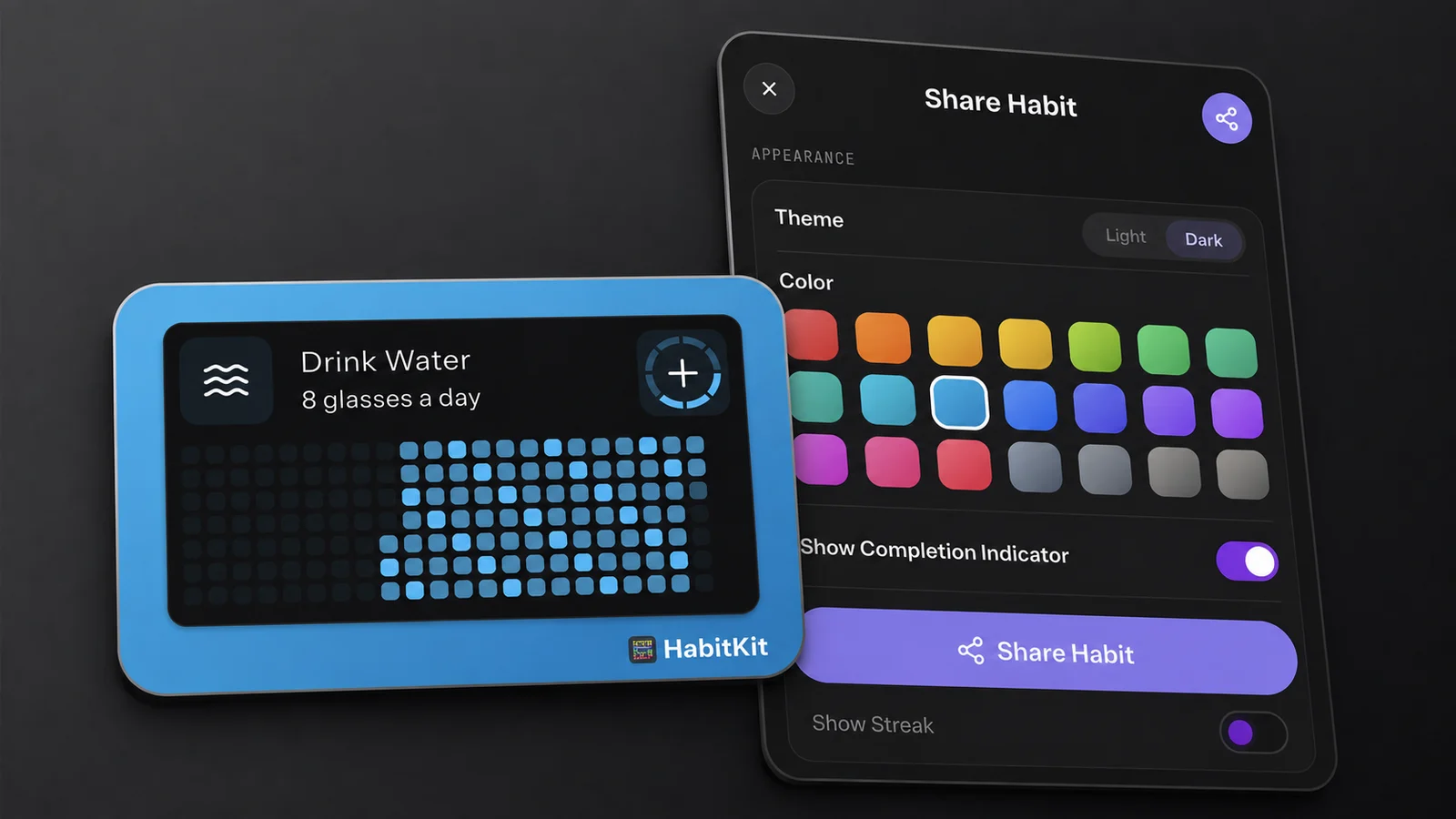
HabitKit can share a record of completions. This is demo data, not a result from the studies below.
A Large Experiment On Exercise
The design is called a megastudy: instead of one intervention tested in one sample, many interventions are tested in the same population, on the same measured outcome, for the same length of time, so the results can actually be compared.
Thirty scientists from fifteen US universities worked in small independent teams to design fifty-four different four-week digital programmes encouraging exercise. The population was 61,293 members of an American fitness chain, and the outcome was gym visits, counted from the chain's own check-ins rather than reported by the participant. It ran with the chain's cooperation, and every one of the programmes was preregistered.
Worth naming the limit before the result: these are people who had already joined a gym, in one country, with one company. That is not a cross-section of anyone, and the authors say as much.
The Result
Forty-five percent of the fifty-four programmes significantly increased weekly gym visits, by nine to twenty-seven percent. That is a good hit rate. Behavioural science works, in the sense that a decent fraction of well-designed ideas do move a real, objectively counted behaviour.
Eight percent of them produced a change that was still significant and measurable after the four weeks were over.
Both numbers describe statistically detectable effects in this study. The absence of a significant lasting effect does not prove that an intervention left no benefit. The top performer, incidentally, was a programme that gave people a small reward for coming back after a missed workout, which is a quietly interesting thing for a habit tracker to notice.
Studies With Longer-Lasting Effects
The megastudy is not the last word, and it would be dishonest to present it as one.
Gary Charness and Uri Gneezy paid students to attend a gym a set number of times in one month. The paper's own text puts attendance afterwards at more than twice the level of the group that was not paid to attend, and reports that the gap did not decline at all in the weeks following the payments. The abstract is more cautious, claiming only marked increases against the controls, entirely driven by people who had not previously attended regularly. Regular users barely moved. Something durable happened there, and it happened to exactly the people you would want it to happen to.
Temptation bundling shows the same tension inside a single idea. Katherine Milkman, Julia Minson and Kevin Volpp locked page-turner audiobooks to the gym and saw a large initial increase in visits, and then watched the effect decline over the nine weeks of their own study. Six years later Erika Kirgios and colleagues taught the technique rather than only supplying it, and reported a ten to fourteen percent higher likelihood of a weekly workout and ten to twelve percent more weekly workouts, sustained up to seventeen weeks after the intervention.
So: an effect that faded inside its own study, and a later, better-designed version of the same effect that did not. That is what an unresolved question looks like, and it is more honest to leave it unresolved than to pick the study that suits the argument.
Why Lasting Is A Different Problem
There is a reason the two halves of this come apart. Alexander Rothman argued in 2000 that starting and continuing run on different criteria. You start because you expect the outcome to be worth it. You keep going because you are satisfied with the outcome you have actually received. The first is a forecast. The second is a review.
A systematic review by Dominika Kwasnicka and colleagues in 2016 read more than a hundred behaviour theories and found maintenance explained by five interlocking things: your motives for keeping going, self-regulation, habits, psychological and physical resources, and your environment and the people in it. Note what is missing from that list. Enthusiasm at the start.
The review offers several possible explanations for a habit ending; it does not rank dissatisfaction above forgetting. If you want the version of that argument about effort and self-discipline, habits and willpower covers it.
What Progress Monitoring Can Help With
Harkin and colleagues pooled 138 randomised studies involving 19,951 people. Progress-monitoring interventions improved goal attainment on average, with an effect size of d = 0.40. Effects were larger when progress was physically recorded or outcomes were reported or made public.
That supports keeping a record as one useful tool. It does not establish the effectiveness of HabitKit or mean that sharing is necessary. A private grid may be the record you prefer.
When evaluating any habit advice, ask what the study measured and for how long. A benefit during a programme does not establish a lasting benefit after it ends.
Sources
- Milkman, K. L., Gromet, D., Ho, H., et al. (2021). Megastudies improve the impact of applied behavioural science. Nature, 600(7889), 478-483. 10.1038/s41586-021-04128-4
- Charness, G., & Gneezy, U. (2009). Incentives to exercise. Econometrica, 77(3), 909-931. 10.3982/ECTA7416
- Milkman, K. L., Minson, J. A., & Volpp, K. G. M. (2014). Holding the Hunger Games hostage at the gym: An evaluation of temptation bundling. Management Science, 60(2), 283-299. 10.1287/mnsc.2013.1784
- Kirgios, E. L., Mandel, G. H., Park, Y., Milkman, K. L., Gromet, D. M., Kay, J. S., & Duckworth, A. L. (2020). Teaching temptation bundling to boost exercise: A field experiment. Organizational Behavior and Human Decision Processes, 161, 20-35. 10.1016/j.obhdp.2020.09.003
- Rothman, A. J. (2000). Toward a theory-based analysis of behavioral maintenance. Health Psychology, 19(1S), 64-69. 10.1037/0278-6133.19.Suppl1.64
- Kwasnicka, D., Dombrowski, S. U., White, M., & Sniehotta, F. (2016). Theoretical explanations for maintenance of behaviour change: A systematic review of behaviour theories. Health Psychology Review, 10(3), 277-296. 10.1080/17437199.2016.1151372
- Harkin, B., Webb, T. L., Chang, B. P. I., Prestwich, A., Conner, M., Kellar, I., Benn, Y., & Sheeran, P. (2016). Does monitoring goal progress promote goal attainment? A meta-analysis of the experimental evidence. Psychological Bulletin, 142(2), 198-229. 10.1037/bul0000025
Only 8% of interventions induced behaviour change that was significant and measurable after the four-week intervention.