
No 01 · Habit science
How To Get Back On Track After Breaking A Streak
By Sebastian Röhl, creator of HabitKit
19 min read Published
To get back on track after breaking a streak, do a small version of the habit at the next normal opportunity, today if you can, and don't wait for Monday. The missed days matter far less than what you decide about them: in the best real-time studies of lapses, the people who slid back were the ones who felt like giving up, not the ones who simply slipped.
Then make the next break easier to survive. Planned slack, such as keeping a daily aim with a couple of allowed skips a week, helped people bounce back after a miss in a randomised trial. Treating yourself kindly helps you stay in the game, though it won't prevent the next slip on its own.
On this page

Your Restart, In Five Steps
Each step links to the research behind it further down.
- Restart today, smaller. Do the short version: one page, one stretch, shoes on and out the door. A short break costs less than it feels like, and a smaller habit is easier to restart (restart smaller).
- Name what got in the way. A busy week, a trip, an illness. A cause you can see is one you can plan around; "I have no discipline" is not (a lapse is not a relapse).
- Don't try to make up the missed days. Doubling up after a gap sets a target you're likely to miss again (the all-or-nothing trap).
- Build slack into the goal. Keep the daily aim, but allow yourself a couple of skips a week, so the next miss is part of the plan (planned slack beats a perfect record).
- Decide now what you'll do next time. "If I miss a day, I'll do the short version the next morning." Planning for obstacles has trial support (plan the comeback).
Where HabitKit Sits
HabitKit has no streak freeze, skip day or streak repair, so it can't pretend a miss didn't happen. What it does instead:
The grid keeps the record. A broken streak leaves every earlier tile on screen. Months of filled days with one gap look like what they are, a good record with a gap, rather than a counter back at zero. The streak number on the dashboard is off unless you turn it on (a streak is not a consistency score).
A weekly or monthly goal is built-in slack. Set a habit to five days a week and two misses are part of the plan, not a broken streak. It's the nearest thing in HabitKit to the "emergency reserves" in the research below: you can keep treating every day as the aim and let the weekly target absorb the misses (taking a day off).
A smaller goal starts from today. For a Count or Measure habit, lowering the daily goal applies from today, and earlier days keep the goals they had, so restarting smaller doesn't rewrite your history (daily goals).
A day note can hold the cause. Long-press a day to add a note about what got in the way. If you did the habit and only forgot to log it, fix the past day; that records what happened rather than excusing a miss.
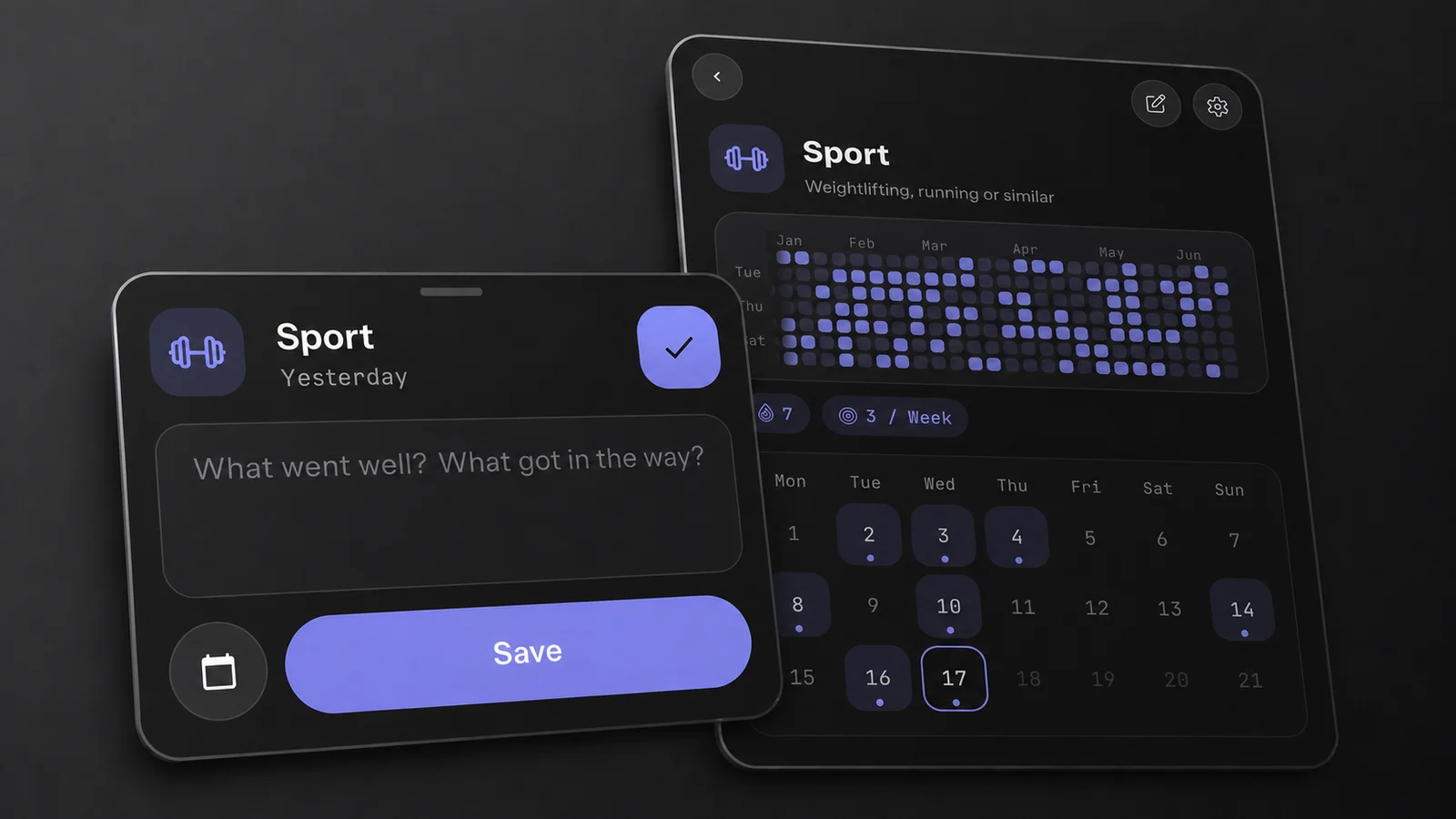
The day editor has a place to record what helped and what got in the way. This demo uses Sport.
A Lapse Is Not A Relapse
Researchers who study quitting draw a line between a lapse, a single slip, and a relapse, a return to the old pattern. The classic theory, from Alan Marlatt's work on addiction, said what turns one into the other is how you explain the slip: blame your character ("I have no willpower") and feel guilty, and the slip snowballs.
The best test of that idea is surprising. Saul Shiffman and colleagues gave 133 people who had just quit smoking palm-top computers to record their first lapse, and how they felt about it, within minutes. Over the following three months, self-blame, guilt and confidence after that first lapse "generally failed to predict" relapse. Two things did. People who felt like giving up after the first lapse reached a second one faster. People who tried to get back on track straight away were less likely to lapse again that day.
A later study of 203 quitters and 1,001 lapses refined it: across repeated lapses, a drop in confidence that they could stay quit sped up the next lapse, while blaming themselves was, if anything, slightly protective. In a study published in 2025, 81 Dutch adults trying to lose weight reported on their days for two weeks; those more confident they could get back on track after a slip were less likely to lapse on exercise and diet.
Outside smoking the evidence is smaller. In 50 women who binge eat, explaining a binge by fixed, global causes went with the next one coming sooner. In 41 people on a very low calorie diet, the more they put their first lapse down to character, the less weight they lost.
The All-Or-Nothing Trap
The danger after a miss is the thought that the record is ruined, so why bother. Psychologists have studied it since the 1970s, when dieters who had already drunk a large milkshake ate more ice cream afterwards, not less, while non-dieters ate less. In a 2010 version, everyone got the same slice of pizza, but dieters who believed theirs was bigger than someone else's ate more cookies afterwards. The belief that they'd blown it, not the calories, seemed to drive it. Researchers call it the "what-the-hell" effect.
It isn't only about food. In two experiments by Dilip Soman and Amar Cheema, people who broke a goal they had set did worse afterwards than people who never set one. At industrial laundry plants with an award for perfect attendance, workers who lost their chance at it after one late day got worse, not just in punctuality but in their other work too.
The practical lesson is to avoid goals that a single miss can ruin, and to avoid "catching up": a missed Monday is not a debt you pay on Tuesday.
Planned Slack Beats A Perfect Record
The closest science to a streak freeze comes from Marissa Sharif and Suzanne Shu. In a five-week field study, 273 students and staff got a daily step goal 20% above their own baseline and were randomly assigned to one of four versions: hit it every day; hit it five days a week; hit it every day but with two "emergency skips" a week; or every day with eight skips a month.
The groups with emergency skips did best. They reached their goal on about four days a week, against about three for the five-day group and fewer for the every-day group, and walked over a thousand more steps a day. The finding that matters most here: the day after a first miss in a week, 60% of the weekly-skip group got back on track, against 42% of the five-days group and 38% of the every-day group. In lab studies, the authors found why: using a reserve keeps the feeling of continuous progress, so commitment survives the miss. A 2017 paper by the same authors found people also try harder so as not to spend their reserves.
Flexibility helps in a related way. In a randomised trial with 2,508 Google employees, John Beshears, Katy Milkman and colleagues paid people for gym visits for four weeks. Paying for visits at any time built more lasting habits than paying only for visits in a two-hour window people chose themselves: in the four weeks after the payments ended, the flexible group was 6 percentage points more likely to keep visiting at least weekly. And in studies by Maura Scott and Stephen Nowlis, people were more likely to recommit to a goal set as a range, such as losing two to four pounds, than to a single number.
Notice what didn't work as well: simply lowering the goal to five days a week did only a little better than demanding all seven. Keeping the daily aim and framing the slack as a reserve made the difference. The skips were also limited and explicit, not unlimited. Slack works when it's part of the goal from the start, not an excuse invented after the fact.
Don't Wait For Monday
Fresh starts are real. Hengchen Dai, Katy Milkman and Jason Riis found that Google searches for "diet", gym visits and commitment contracts all jump at the start of a week, a month, a year or a semester. In experiments, calling March 20 "the first day of spring" rather than "the third Thursday in March" more than tripled the share of people who wanted a goal reminder that day. Their explanation fits a restart well: a new beginning puts your imperfect past self in a previous chapter.
But the limits matter more than the effect. Fresh starts measure people starting, not sticking. In a randomised trial with 15,011 people, reminders tied to birthdays or the New Year did not improve daily medication adherence. And a 2020 study found that when an upcoming fresh start is on people's minds, they ease off now and don't necessarily make up the lost ground afterwards. In a field experiment, aspiring dieters even gave up a week of a paid weight-loss program so they could start on a "fresh" day.
So use the feeling, not the date. Any marker that means something to you, the end of a trip, the first day back at work, can draw the line under a lapse. Tomorrow morning works too.
Be Kind, But Expect Kindness To Do Only Part Of The Job
Self-compassion is the most common advice after a slip, and the best recent studies support a more modest version of it.
Two studies tracked people in the hours after real lapses in their diets. In 140 people in a weight-loss program, responding to a slip with self-compassion went with feeling less bad and feeling more in control of eating over the next hours, but it did not predict whether they lapsed again that day. In 56 people over two weeks, a more self-compassionate response went with stronger intentions and confidence to carry on, but not with more weight lost.
A meta-analysis of 94 studies found self-compassion correlates with healthier behaviour, and that multi-session self-compassion programs improved health behaviour while one-off exercises had no significant effect. Earlier lab work, including a study in which a brief self-compassion message after "breaking" a diet reduced overeating among strict dieters, came from single sessions with student samples.
The fair summary: kindness toward yourself keeps you in the game after a slip, partly because it protects the confidence that you can come back. It is not a guarantee against the next one.
Restart Smaller
A break usually costs less than it feels like. In a classic study of trained endurance athletes who stopped completely, aerobic fitness fell about 7% in the first three weeks. A 2021 review found endurance can be held for months on as few as two sessions a week, and strength on one session a week, as long as the effort stays hard. In a randomised trial, young adults who cut their strength training to a third, or even a ninth, of the previous amount kept the muscle they'd built; older adults needed more to hold on to it.
For the habit itself, the idea is to keep the cue firing. Research on habits separates the habit of starting something from the habit of doing all of it, and the starting habit predicts how often people act. That suggests doing a small version keeps the trigger alive while you rebuild, though we found no study that tests the small-version strategy for restarting directly. Treat it as a reasonable inference.
Starting smaller also guards against what two psychologists called "false hope syndrome": expecting to change faster and more than you can, failing, and starting again with the same unrealistic plan. Our guide to starting smaller than feels worthwhile has heuristics for picking the size.
If the break came from a big change, a move, a new job, a baby, there's an upside. In a field experiment with 800 households, an intervention to encourage more sustainable everyday habits worked better among people who had moved within the previous three months. The same disruption that broke the old routine is a window to build the habit into the new one.
Plan The Comeback Before You Need It
The best-tested planning tool here is the coping plan: deciding in advance how you'll handle the obstacles you expect. In a randomised trial with 211 heart patients, Falko Sniehotta and colleagues found that only the group who made both action plans (when and where to exercise) and coping plans (what to do when something gets in the way) exercised significantly more two months later.
We found no study that tests an "if I miss, then..." plan for restarting specifically. It's a natural extension of coping planning, and it's cheap: write one line now, such as "if I miss a run, I'll do a ten-minute walk the next morning", and the decision after a miss is already made.
When The Streak Was Very Long
Losing a long streak can genuinely hurt. In interviews with 17 recreational runners whose run streaks of 100 days or more had ended, some had run injured to keep the streak alive. When it ended they described sadness, anger and disappointment, sometimes for weeks, and often relief too. Every runner who was physically able kept running, and most started a new streak. It's a small, self-selected group, but a hopeful one.
If the streak number has started running you, rather than the other way round, that's a reason to switch it off and let the grid tell the story. Our essay on what one missed day does to a habit covers the research on how much a single gap actually costs.
What The Research Doesn't Say
- "Never miss twice" has never been tested. It's a memorable rule of thumb. The one study usually cited for it looked at single missed days, not two in a row.
- No peer-reviewed study has tested streak freezes or streak repair in a habit app. Duolingo has reported on its blog that letting learners hold two streak freezes instead of one raised daily active learners by 0.38%, without methods. The emergency-reserve trial above is the honest scientific support.
- "Beating yourself up causes relapse" is only partly supported. In the best real-time data, giving up and losing confidence predicted relapse; self-blame on its own mostly didn't.
- "Restart on Monday" has the evidence backwards. Fresh starts help people begin; waiting for one costs effort in the meantime.
Sources
- Shiffman, S., Hickcox, M., Paty, J. A., Gnys, M., Kassel, J. D., & Richards, T. J. (1996). Progression from a smoking lapse to relapse: Prediction from abstinence violation effects, nicotine dependence, and lapse characteristics. Journal of Consulting and Clinical Psychology, 64(5), 993-1002. 10.1037/0022-006X.64.5.993
- Kirchner, T. R., Shiffman, S., & Wileyto, E. P. (2012). Relapse dynamics during smoking cessation: Recurrent abstinence violation effects and lapse-relapse progression. Journal of Abnormal Psychology, 121(1), 187-197. 10.1037/a0024451
- Roordink, E. M., et al. (2026). Affective and cognitive predictors of lapse in exercise and dietary behavior: An ecological momentary assessment study amongst Dutch adults trying to lose weight. Psychology & Health, 41(8), 1103-1120. 10.1080/08870446.2025.2509070
- Grilo, C. M., & Shiffman, S. (1994). Longitudinal investigation of the abstinence violation effect in binge eaters. Journal of Consulting and Clinical Psychology, 62(3), 611-619. 10.1037/0022-006X.62.3.611
- Mooney, J. P., Burling, T. A., Hartman, W. M., & Brenner-Liss, D. (1992). The abstinence violation effect and very low calorie diet success. Addictive Behaviors, 17(4), 319-324. 10.1016/0306-4603(92)90038-W
- Witkiewitz, K., & Marlatt, G. A. (2004). Relapse prevention for alcohol and drug problems: That was Zen, this is Tao. American Psychologist, 59(4), 224-235. 10.1037/0003-066X.59.4.224
- Herman, C. P., & Mack, D. (1975). Restrained and unrestrained eating. Journal of Personality, 43(4), 647-660. 10.1111/j.1467-6494.1975.tb00727.x
- Polivy, J., Herman, C. P., & Deo, R. (2010). Getting a bigger slice of the pie: Effects on eating and emotion in restrained and unrestrained eaters. Appetite, 55(3), 426-430. 10.1016/j.appet.2010.07.015
- Dritschel, B., Cooper, P. J., & Charnock, D. (1993). A problematic counter-regulation experiment: Implications for the link between dietary restraint and overeating. International Journal of Eating Disorders, 13(3), 297-304. DOI
- Soman, D., & Cheema, A. (2004). When goals are counterproductive: The effects of violation of a behavioral goal on subsequent performance. Journal of Consumer Research, 31(1), 52-62. 10.1086/383423
- Gubler, T., Larkin, I., & Pierce, L. (2016). Motivational spillovers from awards: Crowding out in a multitasking environment. Organization Science, 27(2), 286-303. 10.1287/orsc.2016.1047
- Sharif, M. A., & Shu, S. B. (2021). Nudging persistence after failure through emergency reserves. Organizational Behavior and Human Decision Processes, 163, 17-29. 10.1016/j.obhdp.2019.01.004
- Sharif, M. A., & Shu, S. B. (2017). The benefits of emergency reserves: Greater preference and persistence for goals that have slack with a cost. Journal of Marketing Research, 54(3), 495-509. 10.1509/jmr.15.0231
- Beshears, J., Lee, H. N., Milkman, K. L., Mislavsky, R., & Wisdom, J. (2021). Creating exercise habits using incentives: The trade-off between flexibility and routinization. Management Science, 67(7), 4139-4171. 10.1287/mnsc.2020.3706
- Scott, M. L., & Nowlis, S. M. (2013). The effect of goal specificity on consumer goal reengagement. Journal of Consumer Research, 40(3), 444-459. 10.1086/670766
- Dai, H., Milkman, K. L., & Riis, J. (2014). The fresh start effect: Temporal landmarks motivate aspirational behavior. Management Science, 60(10), 2563-2582. 10.1287/mnsc.2014.1901
- Dai, H., Milkman, K. L., & Riis, J. (2015). Put your imperfections behind you: Temporal landmarks spur goal initiation when they signal new beginnings. Psychological Science, 26(12), 1927-1936. 10.1177/0956797615605818
- Dai, H., Mao, D., Riis, J., Volpp, K. G., Relish, M. J., Lawnicki, V. F., & Milkman, K. L. (2017). Effectiveness of medication adherence reminders tied to "fresh start" dates: A randomized clinical trial. JAMA Cardiology, 2(4), 453-455. 10.1001/jamacardio.2016.5794
- Koo, M., Dai, H., Mai, K. M., & Song, C. E. (2020). Anticipated temporal landmarks undermine motivation for continued goal pursuit. Organizational Behavior and Human Decision Processes, 161, 142-157. 10.1016/j.obhdp.2020.06.002
- Hennecke, M., & Converse, B. A. (2017). Next week, next month, next year: How perceived temporal boundaries affect initiation expectations. Social Psychological and Personality Science, 8(8), 918-926. 10.1177/1948550617691099
- Hagerman, C. J., Ehmann, M. M., Taylor, L. C., & Forman, E. M. (2023). The role of self-compassion and its individual components in adaptive responses to dietary lapses. Appetite, 190, 107009. 10.1016/j.appet.2023.107009
- Thøgersen-Ntoumani, C., Dodos, L. A., Stenling, A., & Ntoumanis, N. (2021). Does self-compassion help to deal with dietary lapses among overweight and obese adults who pursue weight-loss goals? British Journal of Health Psychology, 26(3), 767-788. 10.1111/bjhp.12499
- Phillips, W. J., & Hine, D. W. (2021). Self-compassion, physical health, and health behaviour: A meta-analysis. Health Psychology Review, 15(1), 113-139. 10.1080/17437199.2019.1705872
- Adams, C. E., & Leary, M. R. (2007). Promoting self-compassionate attitudes toward eating among restrictive and guilty eaters. Journal of Social and Clinical Psychology, 26(10), 1120-1144. 10.1521/jscp.2007.26.10.1120
- Coyle, E. F., Martin, W. H., Sinacore, D. R., Joyner, M. J., Hagberg, J. M., & Holloszy, J. O. (1984). Time course of loss of adaptations after stopping prolonged intense endurance training. Journal of Applied Physiology, 57(6), 1857-1864. 10.1152/jappl.1984.57.6.1857
- Spiering, B. A., Mujika, I., Sharp, M. A., & Foulis, S. A. (2021). Maintaining physical performance: The minimal dose of exercise needed to preserve endurance and strength over time. Journal of Strength and Conditioning Research, 35(5), 1449-1458. 10.1519/JSC.0000000000003964
- Bickel, C. S., Cross, J. M., & Bamman, M. M. (2011). Exercise dosing to retain resistance training adaptations in young and older adults. Medicine & Science in Sports & Exercise, 43(7), 1177-1187. 10.1249/MSS.0b013e318207c15d
- Gardner, B., Phillips, L. A., & Judah, G. (2016). Habitual instigation and habitual execution: Definition, measurement, and effects on behaviour frequency. British Journal of Health Psychology, 21(3), 613-630. 10.1111/bjhp.12189
- Polivy, J., & Herman, C. P. (2002). If at first you don't succeed: False hopes of self-change. American Psychologist, 57(9), 677-689. 10.1037/0003-066X.57.9.677
- Verplanken, B., & Roy, D. (2016). Empowering interventions to promote sustainable lifestyles: Testing the habit discontinuity hypothesis in a field experiment. Journal of Environmental Psychology, 45, 127-134. 10.1016/j.jenvp.2015.11.008
- Sniehotta, F. F., Scholz, U., & Schwarzer, R. (2006). Action plans and coping plans for physical exercise: A longitudinal intervention study in cardiac rehabilitation. British Journal of Health Psychology, 11(1), 23-37. 10.1348/135910705X43804
- Ingalls, E., Larade, N., Özakinci, G., Tymowski-Gionet, G., Fleig, L., & Dombrowski, S. U. (2026). The dark side of streaking: Examining the backfire potential of run streaking in recreational runners who broke a long-term streak. PLOS ONE, 21, e0317254. 10.1371/journal.pone.0317254
- Mansur, O. (2022). The habit-building research behind your Duolingo streak. Duolingo blog. Company-reported, not peer-reviewed.
participants who felt like giving up after the first lapse progressed more rapidly to a second lapse